Finding a trader to copy is easy.
Finding a good copy trader is much harder.
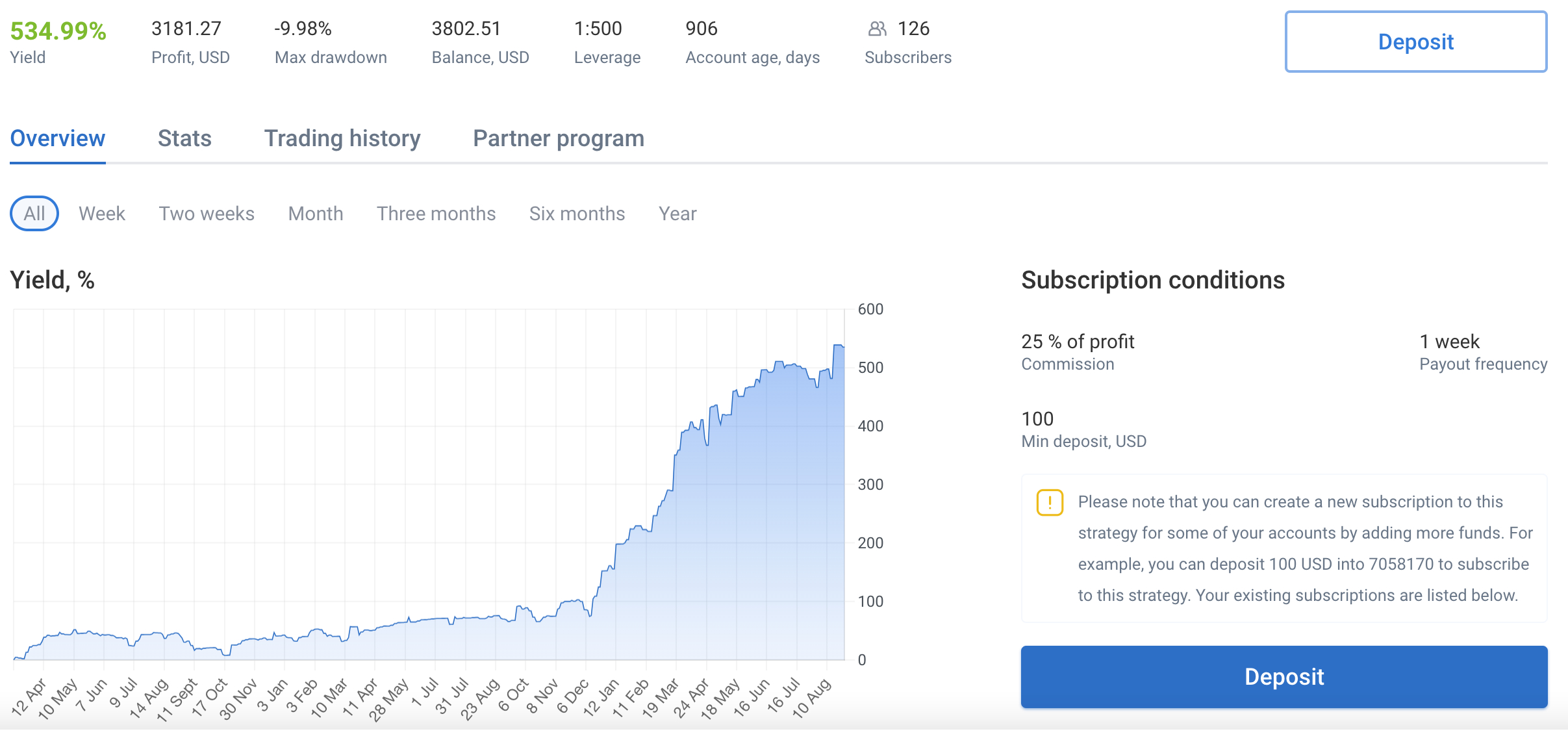
Most copy trading platforms put performance numbers, rankings and returns directly in front of you. It is tempting to simply look for the trader with the highest return and click Copy.
That is exactly where many traders make their first mistake.
A high return doesn’t tell you how much risk was taken to achieve it. A trader can make 100% in a short period while taking enormous positions, using aggressive leverage or holding losing trades until the market eventually turns.
A good copy trader isn’t necessarily the one with the highest return.
It is the trader whose strategy, risk management and track record make sense when you look beyond the headline number.
1. A Good Copy Trader Has a Meaningful Track Record
The first thing to look at is how long the trader has been active.
A few profitable weeks don’t tell you very much.
A strategy can perform exceptionally well simply because current market conditions happen to suit it. Once the market changes, the same strategy can behave completely differently.
A longer live track record gives you more information about how the trader handles different situations.
Ideally, you want to see periods of:
- Strong trends
- Sideways markets
- High volatility
- Difficult market conditions
- Losing periods
The important question isn’t simply how long has the trader existed?
It is:
What has the trader experienced during that time?
A two-year record covering different market conditions tells you considerably more than a two-year record generated by essentially one market environment.
2. Look at Drawdown Before Return
If there is one metric you should never ignore when evaluating a copy trader, it is maximum drawdown.
Drawdown shows how far the account fell from a previous high before recovering.
Imagine two traders:
Trader A: +60% return, maximum drawdown 12%
Trader B: +150% return, maximum drawdown 55%
Trader B looks much better if you only look at the return.
But the path to that return was dramatically more aggressive.
The second trader may be completely unsuitable for someone who cannot tolerate large losses.
Maximum drawdown should therefore always be considered alongside performance. Current copy trading guidance also highlights drawdown as one of the most important metrics when evaluating providers.
3. Consistency Matters More Than One Big Month
A good copy trader doesn’t need to produce spectacular returns every month.
In fact, a steady performance profile can be much more interesting than a strategy that occasionally explodes upwards.
Imagine a trader with this kind of history:
+5%
+4%
-2%
+6%
+3%
+5%
Compare that with:
+45%
-30%
+70%
-40%
+80%
The second record might ultimately show a higher return.
But it also tells you that the strategy is highly volatile.
When choosing a trader to copy, look at the shape of the equity curve, not just the final percentage.
A more consistent strategy can also be easier to stick with when the inevitable losing period arrives.
4. High Win Rate Doesn’t Mean Good Trading
A high win rate looks impressive.
But it can be one of the most misleading numbers in copy trading.
A trader could win 80% of their trades and still lose money.
For example:
- 8 winning trades at +$50 = +$400
- 2 losing trades at -$300 = -$600
The trader won 80% of the time.
The result was still -$200.
This is why win rate needs to be considered together with average win, average loss and overall profitability.
A trader with a 40% win rate can be highly profitable if the average winner is significantly larger than the average losing trade.
Win rate alone tells you very little.
5. Check How the Trader Uses Risk
A good copy trader should have a risk profile that you can actually tolerate.
Look at position sizes.
Look at leverage.
Look at how many positions are open simultaneously.
Look at whether the trader concentrates heavily on one market.
And pay attention to what happens when trades move against them.
A trader who regularly increases position size after losses deserves particular scrutiny.
The strategy may look smooth until the market moves strongly in the wrong direction.
6. Be Careful With Martingale and Grid Strategies
Some strategies can produce remarkably smooth equity curves while hiding substantial risk.
Martingale is a classic example.
The trader increases the position size after a loss, hoping that a later winning trade will recover previous losses.
This can produce many small winning periods.
The problem becomes obvious when the market continues moving against the strategy.
Grid strategies can create a similar issue when positions continue accumulating as the market moves in one direction.
These approaches aren’t automatically unsuccessful.
But as a copier, you need to understand what is happening underneath the performance chart.
A smooth equity curve doesn’t automatically mean low risk.
7. A Good Copy Trader Has a Clear Trading Style
You should be able to understand what the trader actually does.
Is the trader a scalper?
A day trader?
A swing trader?
A position trader?
Does the trader mainly trade forex, indices, gold, stocks or crypto?
How long are positions normally held?
This matters because the strategy needs to fit your expectations.
A trader who opens dozens of short-term positions every day is very different from someone who holds five positions for several weeks.
Neither is automatically better.
But you should know what you’re signing up for.
8. Look at the Actual Trades
Don’t just look at the performance chart.
If the platform provides access to individual trades, examine them.
Look at:
Entry
Exit
Position size
Holding time
Instrument
Profit and loss
This can reveal things that the headline statistics don’t show.
You may discover, for example, that a supposedly conservative trader regularly holds large losing positions.
Or that almost all of the performance came from one particularly successful trade.
The more transparent the trading history, the easier it is to evaluate the strategy properly.
9. A Good Copy Trader Doesn’t Need to Hide the Losing Trades
Losing trades are part of trading.
Every legitimate strategy will have them.
That makes the way a trader handles losses much more interesting than whether losses exist.
Be cautious if the information available focuses almost exclusively on winners.
Screenshots of successful trades are not a track record.
A meaningful record should allow you to see the bad periods as well as the good ones.
Transparency is particularly important in copy trading because investors are making decisions based on someone else’s historical performance. Regulators such as ESMA specifically identify information, costs, suitability and the qualifications of traders whose trades are copied as relevant areas of supervision.
10. A Good Copy Trader Doesn’t Change Strategy Every Few Weeks
Consistency doesn’t mean that every trade has to look identical.
Markets change.
Good traders adapt.
But there is a difference between adapting and completely changing the strategy.
If a trader suddenly moves from conservative swing trading to highly leveraged short-term positions, that matters.
The strategy you originally decided to copy may no longer be the strategy you’re actually following.
This is one reason ongoing monitoring remains important even after you’ve selected a trader.
What Makes a Good Copy Trader? Look at the Whole Picture
There is no single statistic that tells you whether a trader is good.
Instead, look at the combination.
Track record + drawdown + consistency + risk + trading style + transparency.
That’s much more useful than simply sorting a leaderboard by return.
A useful evaluation could look like this:
| Metric | What to Look For |
|---|---|
| Track record | Meaningful live history |
| Return | Consistent rather than extreme |
| Drawdown | Understandable and tolerable |
| Win rate | Always viewed with average win/loss |
| Risk | Controlled position sizing |
| Leverage | Appropriate for the strategy |
| Trading style | Clearly identifiable |
| Trade history | Transparent |
| Losing periods | Visible |
| Strategy changes | Limited and understandable |
Don’t Confuse Popularity With Quality
Copy trading platforms often show how many people follow a trader or how much capital is being copied.
That’s interesting information.
But it isn’t proof that the trader is good.
A trader can become popular because of one spectacular month.
Once enough people see the return, more followers arrive.
That can create a snowball effect.
Popularity tells you that other people have chosen the trader.
It doesn’t tell you whether you should.
Don’t Chase the Top of the Leaderboard
This is probably the biggest mistake in copy trading.
You open the platform.
You sort by performance.
You see someone with +300%.
You click the profile.
And suddenly that trader looks like the obvious choice.
But what happened before that 300%?
How much leverage was used?
What was the maximum drawdown?
How long has the strategy existed?
Were the results generated through a small number of trades?
What happens if the market changes?
A leaderboard is a useful starting point.
It should never be your entire analysis.
A Good Copy Trader Fits Your Risk
This point is often overlooked.
There is no universally “good” risk level.
A trader with a 20% maximum drawdown may be acceptable to one investor and completely unacceptable to another.
The important question is:
Could you realistically stay invested if the trader experiences their historical maximum drawdown again?
And not just financially.
Psychologically as well.
Because if you stop copying the trader at the worst possible moment, the historical performance becomes irrelevant to you.
What About Returns?
Returns still matter.
Of course they do.
You’re not copying a trader simply to admire their risk management.
But returns should be considered in relation to the risk taken.
A trader generating 30% with a controlled drawdown may be more attractive than someone generating 100% with an enormous drawdown.
There is no magic return-to-risk number that makes a trader automatically good.
The important thing is understanding the relationship.
Can You Find a Perfect Copy Trader?
No.
And that’s important.
Even an excellent historical record cannot guarantee future results.
Markets change.
Strategies stop working.
Traders make mistakes.
Risk can increase.
The performance you see belongs to the past.
It isn’t a promise of what will happen after you start copying.
That is why copy trading should be approached as strategy selection and risk management, not as a search for guaranteed returns.
Red Flags When Choosing a Copy Trader
Some warning signs deserve particular attention.
Be cautious when you see:
Extremely high short-term returns
Very deep drawdowns
Almost no losing trades
A very short track record
Heavy leverage
Large numbers of open losing positions
Martingale or aggressive averaging
A sudden change in trading style
Performance based on only a handful of trades
No transparent trading history
None of these automatically proves that a trader is bad.
But they are reasons to investigate further rather than blindly clicking Copy.
What Makes a Good Copy Trader? The Short Answer
A good copy trader isn’t necessarily the trader making the most money.
A good copy trader is someone with a transparent and meaningful track record, controlled risk, understandable trading behaviour and a strategy that fits your own risk tolerance.
Look at the complete picture.
Don’t chase the biggest number on the leaderboard.
Don’t confuse a high win rate with profitability.
Don’t ignore drawdown.
And don’t assume that a smooth equity curve automatically means low risk.
The goal isn’t to find the trader who looks best today.
It’s to find a strategy whose historical behaviour you understand well enough to decide whether you can live with the risk if the next period doesn’t look anything like the last one.
Overview of Topics