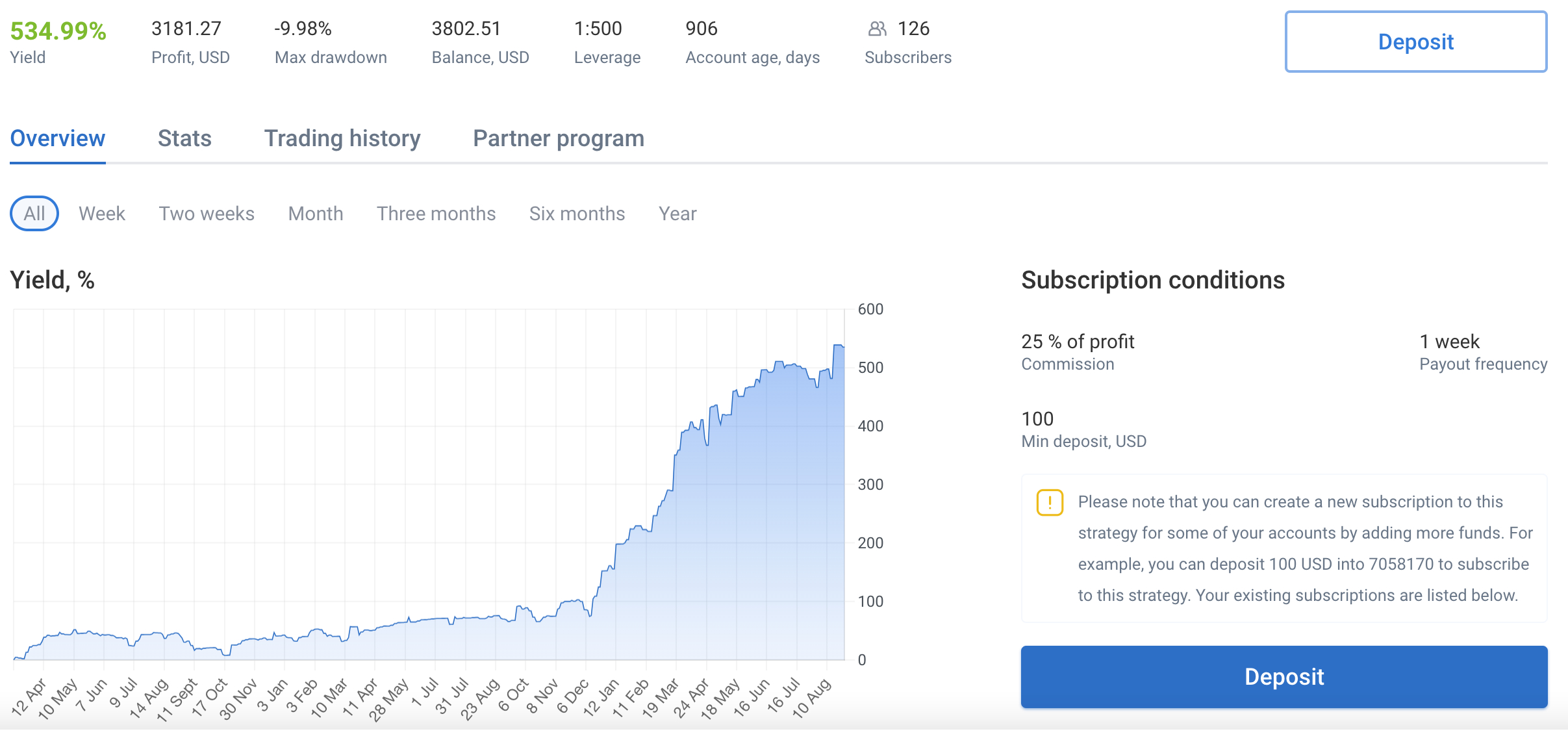
Copy trading strategies determine how a trader makes decisions and how those decisions are replicated in your own trading account.
Unlike traditional investing, where you might buy an ETF or hold individual stocks for years, copy trading can involve actively managed strategies across Forex, indices, commodities, stocks or cryptocurrencies.
The basic concept is straightforward: you choose a trader or strategy provider and the copy trading platform automatically replicates their trades. But the strategy behind those trades determines the risk, trading frequency, potential return and behavior of the account.
This makes understanding different copy trading strategies particularly important.
A trader generating high returns through aggressive scalping has a completely different risk profile from a swing trader holding positions for several days. Likewise, a diversified strategy trading multiple markets can behave very differently from a trader concentrating almost entirely on gold or the Nasdaq.
There is therefore no single best copy trading strategy for everyone.
The right approach depends on your goals, risk tolerance, investment horizon and how much volatility you are prepared to accept.

What Are Copy Trading Strategies?
A copy trading strategy is the systematic approach a trader uses to make trading decisions.
It can define:
- Which markets are traded
- When positions are opened
- How large positions are
- Where stop losses are placed
- When profits are taken
- How losses are managed
- How much leverage is used
- How long positions remain open
- How capital is allocated
When you copy that trader, the platform attempts to replicate these decisions in your account.
Your results may not be identical to the original trader’s results because of differences in execution, spreads, commissions, slippage, account size and other factors.
Understanding the underlying strategy is therefore essential before allocating capital.
The Most Popular Copy Trading Strategies
There are many different approaches to copy trading.
Some of the most common include:
- Trend following
- Swing trading
- Day trading
- Scalping
- Breakout trading
- Momentum trading
- Mean reversion
- News trading
- Position trading
- Diversified multi-market strategies
- Algorithmic trading
- Risk-based portfolio strategies
Each has different advantages and disadvantages.
1. Trend Following
Trend following is one of the most established trading approaches.
The basic idea is simple:
Identify an established market trend and attempt to trade in the direction of that trend.
For example, if an index is consistently making higher highs and higher lows, a trend-following trader may look for buying opportunities.
If the market is moving lower, the trader may look for short positions where permitted.
Trend-following strategies often use tools such as:
- Moving averages
- Trendlines
- Price structure
- Breakouts
- Momentum indicators
- Support and resistance
Advantages of Trend Following
Trend following can work well when markets develop strong directional movements.
It can also be relatively easy to understand.
Disadvantages
The biggest problem occurs during sideways markets.
When price repeatedly changes direction without establishing a clear trend, trend-following strategies can experience multiple losing trades.
When evaluating a copy trader using trend following, look at how the strategy performed during both trending and sideways markets.
2. Swing Trading
Swing trading attempts to capture medium-term market movements.
A swing trader may hold positions for:
- Several hours
- Several days
- Several weeks
depending on the strategy and market.
The objective is generally to capture a larger market movement rather than very small price fluctuations.
Swing traders may use:
- Technical analysis
- Support and resistance
- Chart patterns
- Market structure
- Moving averages
- Momentum
- Fundamental catalysts
Why Swing Trading Can Be Attractive for Copy Trading
Swing trading can involve fewer transactions than scalping.
This may mean:
- Less trading activity
- Potentially lower transaction costs
- Less dependence on ultra-fast execution
- Easier strategy monitoring
However, positions may remain open overnight, which introduces additional risks and potentially financing costs.
3. Day Trading
Day trading involves opening and closing positions within the same trading day.
A day trader generally doesn’t want to hold positions overnight.
Markets commonly traded include:
- Forex
- Indices
- Commodities
- Stocks
Day traders may base decisions on:
- Price action
- Technical indicators
- Market structure
- Economic news
- Breakouts
- Momentum
Advantages
Day trading can limit overnight exposure.
It can also provide frequent trading opportunities.
Disadvantages
Frequent trading can increase:
- Spreads
- Commissions
- Execution costs
- Slippage
When copying a day trader, execution quality can be particularly important.
4. Scalping
Scalping is one of the fastest copy trading strategies.
Positions may remain open for:
- Seconds
- Minutes
- A short period of time
The trader attempts to capture relatively small price movements repeatedly.
Scalping strategies can generate a large number of trades.
Why Scalping Can Be Difficult to Copy
The shorter the holding period, the more important execution becomes.
A strategy provider might enter at one price while your copied position is executed slightly later.
Even a small difference can have a significant impact when the strategy targets very small movements.
Scalping therefore requires careful attention to:
- Spread
- Slippage
- Execution speed
- Commission
- Broker infrastructure
A scalping strategy that performs well for the original trader may not produce exactly the same results for followers.
5. Breakout Trading
Breakout trading focuses on situations where price moves beyond a significant technical level.
For example, a trader may identify resistance at a particular price.
If the market breaks above that level with sufficient momentum, the trader may enter a long position.
The same concept can apply to support levels and short positions.
Breakout traders often monitor:
- Support
- Resistance
- Trading ranges
- Volatility
- Market volume
- Previous highs and lows
Advantages
Breakouts can produce strong movements when markets transition from consolidation into a trend.
Risks
False breakouts are common.
Price may briefly move above resistance and then reverse sharply.
When evaluating a breakout copy trader, look at how the strategy manages failed breakouts and losing positions.
6. Momentum Trading
Momentum strategies attempt to identify markets that are moving strongly and trade in the direction of that movement.
The assumption is that strong price movement may continue for some time.
Momentum traders may use:
- Price acceleration
- Relative strength
- Volume
- Technical indicators
- Market structure
Momentum trading can work particularly well during strong market trends.
However, sudden reversals can create significant losses.
A copy trader using momentum should therefore have clearly defined risk management.
7. Mean Reversion
Mean reversion strategies are based on the idea that prices may eventually move back toward an average or equilibrium level.
For example, if an asset moves significantly away from its recent average, a trader may anticipate a reversal.
Potential tools include:
- Moving averages
- Bollinger Bands
- Statistical measures
- Support and resistance
- Historical price ranges
The Main Risk
Markets don’t have to return to their historical average.
An asset can remain overbought or oversold for a long time.
A mean-reversion trader who continually adds to losing positions can therefore experience substantial losses.
This is particularly important when evaluating strategies that use averaging or increasing position sizes.
8. News Trading
News trading focuses on market-moving economic or political events.
Examples include:
- Interest-rate decisions
- Inflation data
- Employment reports
- Central-bank announcements
- GDP releases
Major announcements can cause very rapid price movements.
News trading can therefore generate large profits and losses within a short period.
Risks of News Trading
During major announcements:
- Spreads can widen
- Slippage can increase
- Liquidity can change
- Prices can move extremely quickly
Copying a news trader requires understanding these execution risks.
9. Position Trading
Position trading is a longer-term approach.
Trades may remain open for:
- Several weeks
- Several months
- Occasionally longer
Position traders generally focus on larger market trends rather than short-term fluctuations.
They may use:
- Fundamental analysis
- Long-term technical analysis
- Macroeconomic trends
- Interest rates
- Economic cycles
Advantages
Position trading generally requires fewer transactions.
It can also reduce the need to react to every short-term price movement.
Disadvantages
Positions can experience significant temporary drawdowns.
Overnight and weekend market movements can also affect leveraged positions.
10. Multi-Market Copy Trading
Some traders don’t specialize in a single market.
Instead, they trade a combination of:
- Forex
- Gold
- Indices
- Commodities
- Stocks
- Cryptocurrencies
This can potentially provide diversification.
However, multiple markets don’t automatically mean lower risk.
Gold and the US dollar, for example, can sometimes be influenced by related macroeconomic factors.
Likewise, several index positions can effectively represent similar exposure to the same underlying economic conditions.
Always analyze the actual correlation between positions.
11. Algorithmic Copy Trading Strategies
Some copy traders use automated trading systems rather than making every decision manually.
An algorithm can identify trading opportunities based on predefined rules.
For example:
- Moving-average crossovers
- Price breakouts
- Volatility conditions
- Momentum
- Statistical relationships
The system can then automatically open and close positions.
Advantages
Algorithmic strategies can provide:
- Consistent execution
- Rule-based decision-making
- Less emotional trading
- Automated monitoring
Risks
Algorithms can also perform poorly when market conditions change.
A strategy optimized for one market environment may struggle in another.
Past backtests are also not guarantees of live performance.
12. Risk-Based Copy Trading Strategies
Some copy traders focus more on risk management than maximum returns.
Instead of trying to generate the highest possible return, the strategy may attempt to maintain controlled volatility and drawdown.
Risk-based approaches can use:
- Position limits
- Maximum exposure
- Volatility targeting
- Diversification
- Stop-loss rules
These strategies may appear less exciting than high-return traders on a leaderboard.
But lower volatility can be valuable for investors who prioritize capital preservation.
What Is the Best Copy Trading Strategy?
There is no universally best strategy.
The best copy trading strategy for you depends on your objectives.
For example:
| Strategy | Typical Holding Period | Main Focus | Main Risk |
|---|---|---|---|
| Scalping | Seconds–minutes | Small price movements | Execution |
| Day trading | Minutes–hours | Intraday moves | Volatility |
| Swing trading | Days–weeks | Medium-term moves | Overnight exposure |
| Trend following | Days–months | Major trends | Sideways markets |
| Momentum | Hours–days | Strong price movement | Reversals |
| Mean reversion | Hours–days | Price returning to average | Persistent trends |
| News trading | Minutes–hours | Economic events | Extreme volatility |
| Position trading | Weeks–months | Long-term trends | Large drawdowns |
The important point is that strategy selection should come before trader selection.
First decide what type of risk and trading style you are comfortable with.
Then look for traders who follow that approach.
How to Evaluate a Copy Trading Strategy
Historical performance should be only the starting point.
Look at the following factors.
Track Record
How long has the strategy been active?
Longer histories provide more information.
Maximum Drawdown
How large were the historical losses?
This can tell you more about risk than the headline return.
Leverage
How much exposure does the strategy take relative to its capital?
Consistency
Are returns spread relatively evenly over time?
Position Size
Does the trader maintain consistent risk per trade?
Losing Streaks
How many consecutive losses have occurred?
Trading Frequency
How many trades does the strategy execute?
Market Exposure
Which instruments and markets are involved?
Recovery Behavior
How does the strategy behave after a losing period?
These factors help you understand the strategy rather than simply its historical result.
Copy Trading Strategies and Risk Management
Risk management should be an integral part of any copy trading strategy.
A strategy can have excellent entries and still lose money if position sizing is poorly controlled.
Important risk management concepts include:
- Risk per trade
- Maximum account exposure
- Stop losses
- Position sizing
- Maximum drawdown
- Leverage
- Diversification
One of the most important questions is:
How much can this strategy lose during an unfavorable market period?
You should know the answer before allocating capital.
Why Drawdown Matters More Than You Think
Suppose two copy traders have identical annual returns.
Trader A:
+30% return / -5% maximum drawdown
Trader B:
+30% return / -25% maximum drawdown
The return is identical.
The risk isn’t.
Trader B required significantly greater historical losses to achieve the same return.
For many investors, Trader A would therefore have a more attractive risk profile.
This demonstrates why evaluating risk-adjusted performance is essential.
Avoid Copy Trading Strategies That Rely on Martingale
Martingale-style strategies deserve special attention.
The basic idea is to increase the position size after a losing trade.
If the next trade wins, the trader hopes to recover the previous losses and generate a profit.
The strategy can produce an impressive win rate for a long time.
But a prolonged losing streak can cause position sizes to grow rapidly.
Eventually, the strategy may face:
- Margin problems
- Very large losses
- Forced liquidation
- Account drawdown
A high historical win rate doesn’t make a martingale strategy safe.
When analyzing copy traders, always investigate whether position sizes increase after losses.
Grid Trading as a Copy Trading Strategy
Grid strategies place multiple orders at different price levels.
The trader may buy as price falls and sell as it rises, attempting to profit from repeated price movements within a range.
Grid systems can perform well in sideways markets.
The problem occurs when the market develops a strong one-directional trend.
The strategy can accumulate increasingly large exposure.
This can create substantial floating losses.
If you see a copy trader using a grid approach, investigate:
- Maximum exposure
- Position limits
- Leverage
- Stop-loss rules
- Historical drawdowns
Don’t evaluate the strategy based only on its win rate.
Diversification Between Copy Trading Strategies
You don’t necessarily have to choose one strategy.
You could potentially combine several different approaches.
For example:
Strategy A: Trend following
Strategy B: Swing trading
Strategy C: Short-term momentum
Strategy D: Long-term position trading
The goal would be to create a portfolio where the strategies don’t all react identically to market conditions.
But diversification should be intentional.
Five traders using almost identical strategies aren’t necessarily more diversified than one trader.
Copy Trading Strategies for Beginners
Beginners should generally prioritize understanding and risk management over maximum returns.
Strategies that are easier to understand can make it easier to evaluate whether the trader is behaving consistently.
For example, a straightforward swing trading strategy with clearly defined risk may be easier to analyze than an opaque algorithm that opens dozens of leveraged positions.
This doesn’t mean simple strategies are safer.
It means transparency is valuable.
Before copying a strategy, make sure you understand:
- What the trader trades
- How frequently they trade
- How large positions are
- How losses are managed
- How leverage is used
- What the historical drawdown has been
How to Compare Different Copy Trading Strategies
A simple comparison table can help.
| Factor | Strategy A | Strategy B | Strategy C |
|---|---|---|---|
| Trading style | Swing | Scalping | Trend following |
| Frequency | Low | High | Medium |
| Holding period | Days | Minutes | Days–weeks |
| Leverage | Moderate | High | Moderate |
| Drawdown | Low | High | Medium |
| Main market | Forex | Indices | Multi-market |
| Main risk | Overnight moves | Execution | Sideways markets |
This kind of comparison makes it easier to see which strategies actually fit your objectives.
Copy Trading Strategy vs. Trader
It’s important to distinguish between the strategy and the person executing it.
A good trader can change their strategy.
For example, a trader who historically used conservative swing trading may suddenly begin:
- Scalping
- Using higher leverage
- Trading different instruments
- Increasing position sizes
- Holding positions overnight
At that point, you are no longer copying the same risk profile you originally selected.
Therefore, monitor not only performance but also behavior.
How Often Should You Review a Copy Trading Strategy?
You don’t need to watch every trade.
But you should periodically review:
- Performance
- Drawdown
- Leverage
- Trading frequency
- Position sizes
- Markets
- Strategy changes
The goal isn’t to interfere with the trader’s decisions.
The goal is to determine whether the strategy still matches the reason you chose it.
What Makes a Copy Trading Strategy Dangerous?
Certain characteristics should immediately make you investigate further.
These include:
- Extremely high leverage
- Rapidly increasing position sizes
- Martingale
- Unlimited averaging down
- No clear risk controls
- Huge historical drawdowns
- Very short track records
- Unrealistically high returns
- Concentrated exposure
- Frequent strategy changes
None of these automatically proves that a strategy will fail.
But they indicate that you need to understand the risk before copying.
Copy Trading Strategies and Leverage
Leverage deserves particular attention because it can dramatically change the risk profile.
A trader who generates 50% using low leverage is fundamentally different from one who generates 50% using extremely high leverage.
The return may look identical.
The potential downside isn’t.
This is especially relevant when strategies involve CFDs or Forex.
Retail investors can lose substantial amounts when trading leveraged products, and European regulators have introduced specific measures addressing CFD risks.
Therefore, never compare copy traders solely on percentage return.
Always ask how much leverage was required to produce that return.
Are Copy Trading Strategies Profitable?
They can be.
But no strategy is guaranteed to remain profitable.
Markets change.
A strategy that worked exceptionally well during a strong trend may struggle during a sideways market.
A mean-reversion strategy can behave differently during a major trend.
A news strategy can behave differently when liquidity conditions change.
This is why historical performance should be treated as evidence to analyze, not as a promise.
How to Choose the Right Copy Trading Strategy
A practical process is:
Step 1: Define Your Risk Tolerance
How much drawdown can you realistically accept?
Step 2: Define Your Time Horizon
Do you want short-term trading or longer-term exposure?
Step 3: Choose a Strategy Type
Decide whether trend following, swing trading, day trading or another approach fits your objectives.
Step 4: Find Suitable Traders
Search for traders who actually use that strategy.
Step 5: Analyze the Risk
Check drawdown, leverage, position sizing and losing streaks.
Step 6: Check the Track Record
Look for sufficient historical data.
Step 7: Start With Appropriate Capital
Don’t allocate more than you can afford to lose.
Step 8: Monitor the Strategy
Make sure the trader continues to follow the approach you selected.
Conclusion: Copy Trading Strategies
There are many different copy trading strategies, and each comes with its own opportunities and risks.
Trend following, swing trading, day trading, scalping, breakout trading, momentum, mean reversion, news trading and position trading can all produce very different results depending on market conditions.
There is no single strategy that is best for everyone.
The most important factor isn’t finding the strategy with the highest historical return. It’s finding a strategy whose risk, drawdown, leverage and trading style match your own objectives.
When evaluating a copy trader, look beyond the headline performance.
Analyze the track record, maximum drawdown, position sizing, leverage, losing streaks, trading frequency and underlying markets. Be particularly careful with strategies that rely on aggressive averaging, martingale techniques or excessive leverage.
And remember that diversification doesn’t automatically mean safety. Copying several traders with almost identical strategies can leave you exposed to the same underlying risks.
Ultimately, successful copy trading starts with understanding the strategy before copying the trader.
Don’t ask only, “How much did this trader make?” Ask, “How did they make it, how much risk did they take, and could I tolerate the same losses?”
That is the difference between blindly copying performance and making an informed copy trading decision.
Overview of Topics