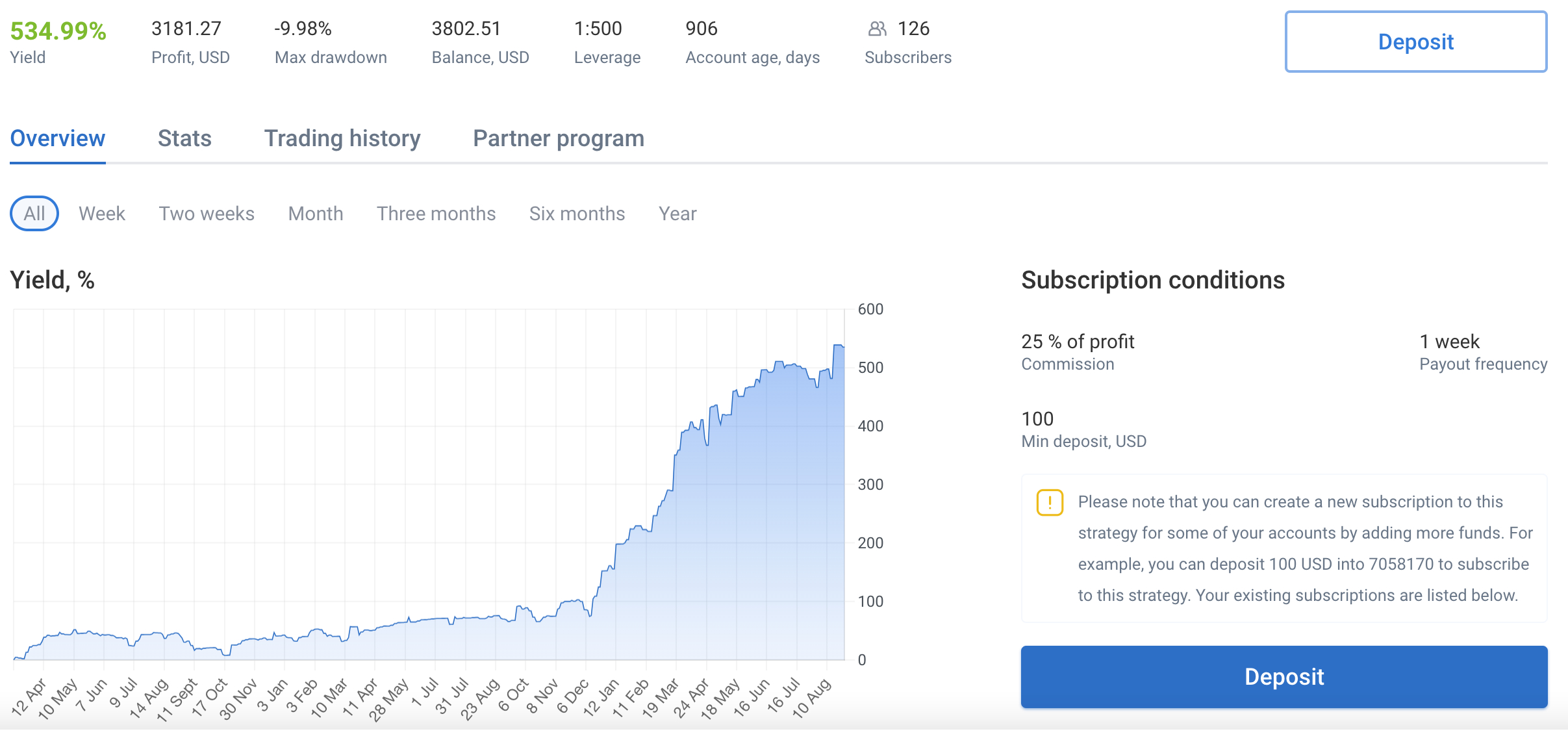
Is copy trading safe? The short answer is: copy trading can be used safely, but it is not risk-free.
Copy trading is a technology that allows you to automatically replicate the trades of another trader. The technology itself is not necessarily dangerous. The real risks come from the broker you use, the trader you copy, the financial products being traded, the amount of leverage involved and the way you manage your capital.
This distinction is important because copy trading is sometimes marketed as an easy way to make money. A platform may show traders with impressive historical returns, allowing users to copy their positions with just a few clicks.
But a successful trader is not automatically a safe trader.
A strategy that generated 100% in one year may have used substantial leverage and experienced a 50% drawdown along the way. Another trader may have generated 20% with considerably less risk.
Therefore, when asking “is copy trading safe?”, you should actually ask several different questions:
- Is the copy trading broker regulated?
- Is my money held securely?
- Is the trader’s performance transparent?
- How much risk does the strategy take?
- Does the strategy use leverage?
- What is the maximum drawdown?
- Could the platform or trader be a scam?
- What happens if the trader loses money?
Understanding these questions is essential before you allocate any capital.
Is Copy Trading Safe or Risky?
Copy trading itself is neither inherently safe nor inherently dangerous.
It is a mechanism for automatically executing another trader’s decisions.
The underlying investments determine much of the risk.
For example, copying a long-term stock investor is very different from copying a highly leveraged Forex trader or an aggressive CFD strategy.
The risk can increase considerably when copy trading involves leveraged products.
The European Securities and Markets Authority (ESMA) has repeatedly warned retail investors about the risks of CFDs and other speculative products, describing them as complex and risky products that can lead to significant losses.
This means that you should never judge the safety of copy trading simply by looking at the platform’s interface.
You need to look at the underlying strategy and financial instruments.
Is Copy Trading Regulated?
Copy trading can fall under financial regulation depending on how the service is structured and where it is offered.
This is particularly important in Europe.
The UK’s Financial Conduct Authority (FCA), for example, explains that copy trading can constitute portfolio or investment management when trades are automatically executed without further manual intervention from the client. In such circumstances, regulatory requirements can apply.
However, this does not mean that every website offering copy trading is regulated.
That distinction is extremely important.
You should always check:
- The legal name of the broker
- The regulator
- The regulatory licence
- The permitted services
- The entity holding your account
- The jurisdiction under which you are trading
Don’t rely solely on a logo saying “regulated” on a website.
Check the regulator’s official register yourself.
Why Broker Regulation Matters
The broker is one of the most important parts of your copy trading setup.
Imagine you find an excellent trader with a five-year track record.
If you copy that trader through an unregulated platform, you have introduced an additional risk that has nothing to do with the trader’s strategy.
An unauthorised company may:
- Refuse withdrawals
- Manipulate account balances
- Use misleading performance statistics
- Disappear with client funds
- Impersonate a legitimate broker
- Use fake regulatory information
The FCA currently warns specifically about unauthorised online trading and investment firms that promise high returns and operate through online platforms.
In December 2025, for example, the FCA issued a warning against a firm using the name FX Copy Trading, stating that it was not authorised and warning consumers about the lack of regulatory protections.
This demonstrates why checking the provider is just as important as evaluating the strategy.
Can Copy Trading Be a Scam?
Yes.
Copy trading itself is not a scam, but scammers can use copy trading as a marketing method.
This is particularly common when an offer promises unusually high or guaranteed returns.
Be extremely careful with statements such as:
- “Guaranteed monthly profits”
- “Risk-free copy trading”
- “Earn 10% every week”
- “Never lose a trade”
- “Our AI guarantees profits”
- “Professional trader with 99% win rate”
- “Passive income without risk”
No legitimate trading strategy can guarantee that financial markets will move in your favor.
The German consumer protection organisation Verbraucherzentrale also warns that social trading and copy trading can be highly speculative and that past performance says nothing about future profits. It specifically highlights misleading marketing and the risk of total loss.
How to Avoid Copy Trading Scams
Before depositing money, investigate the company behind the platform.
Check the Regulatory Register
Don’t just look at the broker’s website.
Find the relevant regulator and search for the company directly.
Check whether:
- The company actually exists
- The licence is active
- The services offered are authorised
- The website domain matches the registered company
This is particularly important because scammers sometimes impersonate legitimate financial companies.
Don’t Trust Screenshots
A screenshot showing a profitable trading account proves very little.
It could be:
- Edited
- From a demo account
- From a different account
- Missing losing trades
- Showing gross rather than net performance
A professional copy trading platform should provide verifiable and sufficiently detailed performance information.
Be Careful With Social Media
Social media is full of trading content showing:
- Luxury cars
- Expensive watches
- Large trading accounts
- Profit screenshots
- Exotic holidays
None of this proves that a trading strategy is legitimate or profitable.
The FCA specifically warns that online trading scams can use social media and professional-looking websites to convince investors to deposit money.
Is Copy Trading Safe With a Regulated Broker?
Using a properly regulated broker can reduce certain operational and fraud risks, but it does not make copy trading risk-free.
This distinction is crucial.
Regulation can provide a framework for how a financial firm must operate and can provide certain investor protections depending on the jurisdiction.
But regulation does not guarantee that:
- The trader you copy will make money
- Your strategy will be profitable
- Your account won’t experience a drawdown
- You won’t lose money trading CFDs
- Market volatility won’t affect your positions
A regulated broker can be legitimate while the strategy you copy performs badly.
Therefore, you need to evaluate broker risk and trading risk separately.
How Safe Is Copy Trading With Leverage?
Leverage is one of the biggest risks in copy trading.
Suppose a trader controls a position worth $100,000 with $10,000 of capital.
They are effectively using significant leverage.
If the market moves strongly in their favor, the return on their capital can be substantial.
But if the market moves against them, the losses can also be substantial.
When you copy the trader, the same underlying risk can be transferred to your account proportionally.
This is why a trader’s return should always be viewed together with their:
- Maximum drawdown
- Position size
- Leverage
- Margin usage
- Stop-loss strategy
A high-return trader may simply be taking much more risk than another trader.
What Is Drawdown in Copy Trading?
Drawdown is one of the most important statistics when determining whether a copy trading strategy is appropriate for you.
Suppose a trader starts with $10,000.
The account grows to $15,000.
It then falls to $12,000.
The strategy has experienced a $3,000 decline from its previous peak.
That’s a 20% drawdown from the $15,000 high.
The trader may eventually recover.
But the important question is whether you would be comfortable seeing your own account fall by a similar percentage.
If you allocate $5,000 to the strategy, a 20% drawdown would represent approximately $1,000.
If you allocate $50,000, it would represent approximately $10,000.
The percentage is identical, but the financial and psychological impact is completely different.
Is a High Win Rate a Sign of Safety?
Not necessarily.
A high win rate can be misleading.
Imagine a trader has:
- 90% winning trades
- 10% losing trades
That sounds excellent.
But what happens if the average winning trade is $50 while the average losing trade is $1,000?
The strategy can still lose money despite winning 90% of its trades.
Some strategies also use techniques that continuously increase position size after losing trades.
The win rate can remain high for a long time while the underlying risk becomes enormous.
That’s why you should never evaluate a copy trader using only one statistic.
What Makes a Copy Trading Strategy Safer?
There is no completely safe trading strategy.
However, some characteristics can make a strategy easier to evaluate.
Long Track Record
A strategy with several years of history gives you more information than one with three months of performance.
Controlled Drawdown
A lower historical drawdown can indicate a more conservative approach.
It doesn’t guarantee future performance, but it provides useful information about historical risk.
Reasonable Leverage
Moderate leverage can reduce the impact of individual market movements compared with highly aggressive strategies.
Transparent Trading History
You should be able to see enough information to understand how the strategy actually behaves.
Consistent Risk
A trader who suddenly doubles or triples their position sizes may be changing the risk profile of the strategy.
Clear Strategy
You should understand what the trader is trying to achieve and which markets they trade.
Should You Copy One Trader or Multiple Traders?
Copying multiple traders can potentially diversify your exposure.
For example, you could allocate capital to different strategies:
- Forex
- Gold
- Indices
- Stocks
- Long-term investing
However, diversification isn’t guaranteed simply because you have multiple traders.
Imagine you copy five Forex traders.
If all five use similar strategies and all are heavily exposed to the US dollar, a major market move could affect all five accounts simultaneously.
Therefore, meaningful diversification requires looking at the underlying exposure, not just the number of traders.
Can You Lose All Your Money With Copy Trading?
Yes, depending on the products, leverage, account structure and strategy, substantial losses can occur.
The exact protection available to you depends on your broker and jurisdiction.
This is particularly important when copying leveraged CFD or Forex strategies.
ESMA has warned that CFDs are complex, speculative products and that retail investors can suffer significant losses.
Never assume that a copy trading platform will automatically prevent your account from losing a large percentage of its value.
Risk controls can help, but they cannot eliminate market risk.
How Much Money Should You Put Into Copy Trading?
There is no universal amount.
The correct allocation depends on your personal circumstances and risk tolerance.
A sensible approach is to avoid putting your entire available capital into one trader.
For example, someone with $10,000 might decide to allocate only a portion to copy trading.
The specific percentage should be based on what they can afford to lose rather than what they hope to make.
The key question isn’t:
“How much can I make?”
It should be:
“How much can I afford to lose without affecting my financial situation?”
That change in perspective can dramatically improve your risk management.
Is Copy Trading Safer Than Trading Yourself?
Not automatically.
Copy trading reduces the need for you to make individual trading decisions.
But you are replacing your own decisions with someone else’s.
When trading manually, you know why you entered the trade.
With copy trading, you may not.
This creates a different type of risk.
For example, the trader might:
- Change their strategy
- Increase leverage
- Start trading a different market
- Increase position sizes
- Hold positions for longer
- Stop using stop-loss orders
If you continue copying automatically, those changes can affect your account.
This is why copy trading still requires monitoring.
How Often Should You Monitor a Copy Trading Strategy?
There is no universal schedule.
It depends on the strategy.
A long-term investor may require less frequent monitoring than an aggressive day trader.
However, you should regularly check:
- Performance
- Drawdown
- Open positions
- Trading frequency
- Leverage
- Strategy changes
The objective isn’t to interfere with every trade.
It’s to make sure the strategy still behaves in a way that matches the reason you selected it.
What Should You Do During a Drawdown?
A drawdown doesn’t automatically mean that a strategy has failed.
Every trading strategy can experience losing periods.
The important question is whether the drawdown is within the historical and expected risk profile.
For example, if a strategy historically experienced maximum drawdowns of 10%, a sudden 35% drawdown should trigger serious investigation.
But stopping a strategy after every losing trade can also be problematic.
You need a predefined risk framework rather than making emotional decisions.
Is Copy Trading Safe for Beginners?
Copy trading can be accessible to beginners, but accessibility shouldn’t be confused with safety.
The interface may be simple.
Selecting a trader may take seconds.
But understanding the risk behind that trader can take considerably longer.
Beginners should understand at least the basics of:
- Leverage
- Drawdown
- Position sizing
- Risk management
- Trading costs
- Market volatility
- CFDs and other leveraged products
If you don’t understand how the underlying product works, you shouldn’t invest simply because another trader appears successful.
Copy Trading Safety Checklist
Before starting a copy trading strategy, ask yourself the following:
- Is the broker regulated?
- Did I verify the licence independently?
- Do I understand which legal entity holds my account?
- Do I understand the products being traded?
- Does the strategy use leverage?
- What is the maximum historical drawdown?
- How long has the trader been active?
- Is the performance independently verifiable?
- What are the total trading costs?
- Can I afford the potential losses?
- Do I understand how to stop copying?
- Do I know what happens to open positions if I stop?
- Does the trader’s strategy match my risk tolerance?
- Am I being promised guaranteed returns?
If several answers are unclear, don’t rush into the investment.
Copy Trading Safety: Broker Risk vs. Strategy Risk
One of the easiest ways to understand copy trading safety is to separate two different risks.
Broker Risk
This includes:
- Fraud
- Unauthorised providers
- Withdrawal problems
- Poor operational controls
- Counterparty risk
- Lack of applicable investor protection
You can reduce some of these risks by choosing a properly authorised broker and verifying its regulatory status.
Strategy Risk
This includes:
- Losing trades
- Drawdowns
- Leverage
- Volatility
- Poor risk management
- Strategy changes
- Correlated positions
Regulation cannot eliminate strategy risk.
A regulated broker can provide a legitimate platform while the trader you copy loses money.
You therefore need to manage both risks independently.
So, Is Copy Trading Safe?
The most accurate answer is:
Copy trading can be used responsibly, but it should never be considered risk-free.
The technology itself simply automates the replication of another trader’s decisions.
Your actual level of risk depends on the broker, the financial instruments, the strategy provider, leverage, position sizing and your own capital allocation.
A properly regulated broker can help reduce certain operational and fraud risks. But it cannot guarantee that the trader you copy will make money.
Likewise, a trader with a long and impressive track record can still experience substantial losses.
The safest approach is therefore not to search for a “risk-free copy trading strategy.”
Instead, look for transparent risk information, appropriate regulation, reasonable leverage, controlled drawdowns and a strategy that matches your own risk tolerance.
Conclusion: Is Copy Trading Safe?
So, is copy trading safe?
It can be, provided that you understand what you are actually doing.
Copy trading is not inherently a scam, and regulated brokers can offer legitimate copy trading services. But the underlying trading activity remains risky, particularly when leverage and CFDs are involved.
The biggest mistake is assuming that copying a successful trader makes your investment safe.
It doesn’t.
You can lose money even when using a regulated broker. The trader can experience a drawdown, change their strategy or take more risk than you expected.
The best way to approach copy trading is therefore to separate platform safety from trading safety.
First, verify the broker and its regulatory status. Then investigate the trader’s track record, drawdown, leverage, trading style and risk management. Finally, allocate only an amount of capital that you can genuinely afford to lose.
Copy trading can make trading easier. It cannot make trading risk-free.
Overview of Topics
- Is Copy Trading Safe or Risky?
- Is Copy Trading Regulated?
- Why Broker Regulation Matters
- Can Copy Trading Be a Scam?
- How to Avoid Copy Trading Scams
- Is Copy Trading Safe With a Regulated Broker?
- How Safe Is Copy Trading With Leverage?
- What Is Drawdown in Copy Trading?
- Is a High Win Rate a Sign of Safety?
- What Makes a Copy Trading Strategy Safer?
- Should You Copy One Trader or Multiple Traders?
- Can You Lose All Your Money With Copy Trading?
- How Much Money Should You Put Into Copy Trading?
- Is Copy Trading Safer Than Trading Yourself?
- How Often Should You Monitor a Copy Trading Strategy?
- What Should You Do During a Drawdown?
- Is Copy Trading Safe for Beginners?
- Copy Trading Safety Checklist
- Copy Trading Safety: Broker Risk vs. Strategy Risk
- So, Is Copy Trading Safe?
- Conclusion: Is Copy Trading Safe?
- Follow Verified Traders Now