Choosing a copy trader is probably the most important decision you make in copy trading.
The technical side is simple. You open an account, deposit money, select a trader and activate the copy function. After that, the platform automatically replicates the trader’s positions in your account.
The difficult part is deciding who you should actually copy.
Most copy trading platforms present users with a large selection of traders. You may see rankings based on performance, number of followers, risk scores or recent returns. At first glance, this looks convenient.
But it can also be dangerous.
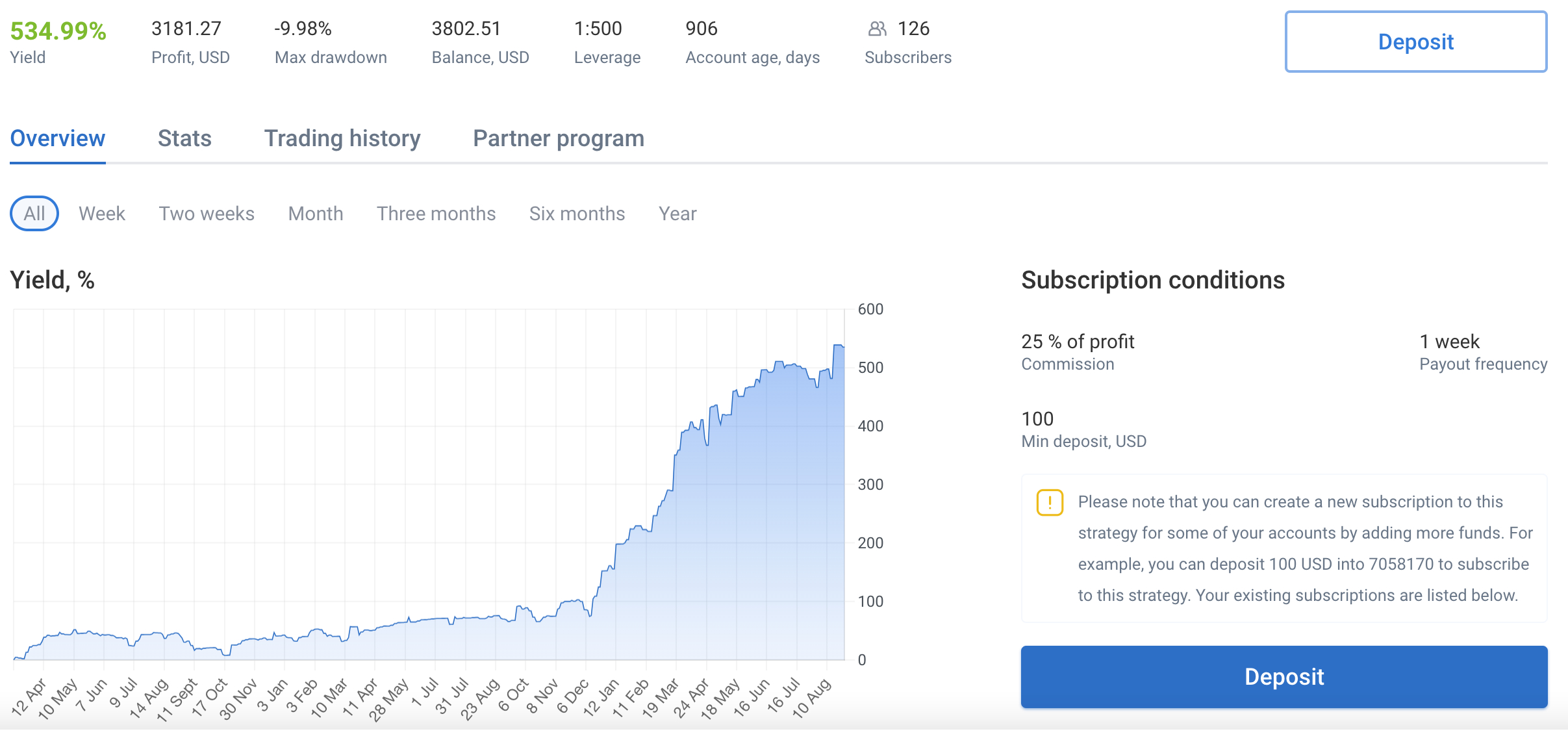
The trader with the highest return isn’t necessarily the best trader. A strategy showing +150% may have achieved that result by using enormous leverage and taking substantial risks. Another trader may have generated +30% over several years while keeping drawdowns relatively controlled.
If you only look at the return, you miss the most important part of the picture: how the return was generated.
This guide explains how to choose a copy trader, which statistics actually matter, what red flags to look for and how to compare different strategy providers before putting your money at risk.
Don’t Choose a Copy Trader Based on Return Alone
The biggest mistake when choosing a copy trader is usually the same:
Sort by highest return → choose the first trader → start copying.
It sounds logical, but it can expose you to far more risk than you realize.
Imagine two traders:
Trader A
- Return: +120%
- Maximum drawdown: -55%
- High leverage
- Aggressive position sizing
Trader B
- Return: +35%
- Maximum drawdown: -9%
- Moderate leverage
- Consistent position sizing
Trader A looks much better if you only consider returns.
But Trader B may be considerably more suitable for someone who wants to control risk.
There is no universal “best copy trader.” The right choice depends on your objectives, risk tolerance and the strategy itself.
The first rule should therefore be:
Never evaluate a copy trader using a single statistic.
What Should You Look for in a Copy Trader?
When comparing traders, focus on several key factors:
- Track record
- Historical return
- Maximum drawdown
- Risk level
- Leverage
- Trading frequency
- Position sizing
- Win rate
- Average profit and loss
- Trading style
- Markets traded
- Consistency
- Strategy transparency
You don’t necessarily need to find a trader who scores perfectly in every category.
Instead, you want to understand the complete risk-return profile.
1. Check the Trader’s Track Record
The first question should be:
How long has this trader actually been trading?
A trader who has generated +80% in three months doesn’t give you nearly as much information as someone who has traded consistently for several years.
A longer track record allows you to see how the strategy behaved during different market environments.
For example:
- Strong bullish markets
- Bear markets
- Sideways markets
- High volatility
- Low volatility
- Major economic events
- Market crashes
A short period of excellent performance can simply be the result of favorable market conditions.
A longer history doesn’t guarantee future profitability, but it gives you more data to analyze.
2. Analyze Maximum Drawdown
If there is one statistic you should pay particular attention to, it is maximum drawdown.
Drawdown tells you how far the strategy fell from a previous high.
Imagine a strategy grows from $10,000 to $15,000.
It then falls to $12,000.
The decline from the $15,000 peak is $3,000, representing a 20% drawdown.
Now imagine that you allocate $5,000 to the same strategy.
A similar 20% drawdown would mean approximately $1,000 less in your account.
This is where copy trading becomes psychological.
You might think you’re comfortable with a 20% drawdown when looking at historical statistics.
Watching your own $1,000 disappear can feel very different.
That’s why you need to ask:
“Could I tolerate this drawdown without making an emotional decision?”
If not, the strategy probably isn’t suitable for you.
3. Don’t Confuse Win Rate With Profitability
A high win rate looks impressive.
But it doesn’t necessarily mean that a trader is good.
Consider this example:
A trader makes 90 winning trades and 10 losing trades.
That gives them a 90% win rate.
Sounds excellent.
But suppose:
- Average winning trade: $50
- Average losing trade: $700
The ten losing trades could wipe out the profits from dozens of winning trades.
This is why win rate should never be analyzed independently.
You also need to look at:
- Average winning trade
- Average losing trade
- Risk-to-reward ratio
- Largest loss
- Losing streaks
A trader with a 50% win rate can be highly profitable if the winners are significantly larger than the losers.
4. Look at Risk-Adjusted Performance
One of the most useful ways to compare copy traders is to consider return relative to risk.
Suppose:
Trader A: +100% return with 50% maximum drawdown
Trader B: +40% return with 10% maximum drawdown
Trader A produced more profit.
But Trader B achieved its return with substantially less historical drawdown.
Depending on your objectives, Trader B may therefore be the more attractive strategy.
The objective isn’t necessarily to maximize the percentage shown on the screen.
It is to find a strategy where the potential return makes sense relative to the risk required to achieve it.
5. Check How Much Leverage the Trader Uses
Leverage deserves special attention when choosing a copy trader.
Leverage increases market exposure relative to the capital available.
This can make profits larger.
It can also make losses larger.
European regulators have repeatedly highlighted leverage as a significant risk factor for retail investors trading CFDs. ESMA introduced restrictions on retail CFD leverage and highlighted concerns about excessive leverage and the potential for significant losses.
Therefore, don’t simply ask:
“How much did this trader make?”
Ask:
“How much leverage did they need to take to make it?”
A trader generating high returns through aggressive leverage may be considerably more vulnerable to a sudden market movement.
6. Examine Position Sizes
Position sizing can tell you a lot about a trader’s risk management.
Imagine a trader normally uses small positions but suddenly opens a position several times larger than usual.
That’s worth investigating.
A trader may have:
- Increased conviction
- Changed their strategy
- Increased leverage
- Attempted to recover losses
- Taken a highly concentrated position
The reason doesn’t necessarily matter as much as the change itself.
Sudden changes in position size can indicate that the strategy’s risk profile is changing.
7. Look for Consistency
Consistency is often more useful than spectacular short-term performance.
Imagine a trader who generates:
- +4%
- +6%
- -2%
- +5%
- +3%
- +7%
That may be more interesting than a trader who generates:
- +80%
- -50%
- +120%
- -60%
Even if the second trader eventually produces a higher overall return, the path to that return is dramatically more volatile.
A consistent strategy can be easier to manage psychologically and financially.
However, “consistent” doesn’t mean the trader must be profitable every month.
Losing months are normal.
What matters is whether the overall risk and performance remain within a reasonable range.
8. Understand the Trader’s Trading Style
Before copying someone, understand what kind of trader they are.
Scalper
Trades may remain open for seconds or minutes.
Execution speed and spreads can have a significant impact.
Day Trader
Trades are usually opened and closed within the same trading session.
Swing Trader
Positions can remain open for several days or weeks.
Position Trader
Trades may remain open for weeks or months.
News Trader
The strategy may specifically target major economic announcements.
These styles have very different risk profiles.
A strategy that is perfectly suitable for a short-term trader may be completely inappropriate for someone looking for a longer-term approach.
9. Check Which Markets the Trader Uses
Don’t ignore the instruments being traded.
A trader specializing in:
- EUR/USD
- GBP/USD
- Gold
- Nasdaq
- S&P 500
- Individual stocks
- Cryptocurrencies
can have very different risk characteristics.
For example, cryptocurrency strategies can experience significantly different volatility from traditional Forex strategies.
Likewise, a trader who focuses heavily on one index may be exposed to a very specific market environment.
You should understand where your money is actually being invested.
10. Analyze the Trading Frequency
How often does the trader trade?
This can tell you a lot about the strategy.
A trader executing hundreds of positions may have very different costs and execution characteristics from someone placing only a few trades per month.
High-frequency trading can increase the importance of:
- Spread
- Commission
- Slippage
- Execution speed
- Overnight costs
Don’t assume that more trades mean more opportunities.
Sometimes it simply means more transaction costs.
11. Look at Losing Streaks
Even profitable traders lose trades.
The question is how the strategy behaves during losing periods.
Imagine a trader historically experiences:
- 2–3 losses in a row regularly
That’s very different from a strategy that occasionally experiences:
- 10–15 consecutive losses
Before copying a trader, understand the historical losing streaks.
Then ask yourself whether you could continue following the strategy during a similar period.
This is particularly important because many people stop copying a strategy precisely when it experiences a temporary losing streak.
12. Look at How the Trader Handles Losses
This is one of the most important things to investigate.
Some traders accept losses and move on.
Others increase position sizes after losing trades.
The latter can be particularly dangerous.
A strategy that increases position sizes after losses may potentially recover quickly if the market reverses.
But if the market continues moving against the trader, losses can increase rapidly.
Watch for patterns such as:
- Increasing lot sizes after losses
- Adding repeatedly to losing positions
- Removing stop-losses
- Holding losing trades for very long periods
- Large single-position exposure
These can indicate aggressive risk management.
13. Be Careful With Martingale Strategies
Martingale-style strategies deserve particular caution.
The basic concept is to increase the position size after a loss, hoping that a future winning trade will recover previous losses.
It can produce impressive-looking win rates for extended periods.
But a sufficiently long losing sequence can create extremely large exposure.
For copy trading, this can be especially dangerous because the strategy’s risk may not be obvious when looking only at historical returns.
A trader can appear highly successful until the market produces exactly the conditions the strategy cannot handle.
If you see rapidly increasing position sizes after losses, investigate carefully before copying.
14. Check Whether the Trader Uses Stop Losses
Stop-loss usage isn’t automatically a sign of a good strategy, but it can provide useful information about risk management.
Find out:
- Does the trader use stop losses?
- How far away are they?
- Are they moved during the trade?
- Are they removed?
- Does the trader average down?
- What happens during extreme volatility?
A strategy without clear downside controls isn’t necessarily bad, but it requires much more careful analysis.
You need to understand how the trader limits risk.
15. Don’t Ignore Overnight Positions
Some traders close everything at the end of the trading day.
Others hold positions overnight.
This can create additional risks and costs.
Depending on the instrument and broker, overnight positions can be affected by:
- Financing costs
- Market gaps
- Economic announcements
- Reduced liquidity
If a trader regularly holds leveraged positions overnight, understand how that affects the strategy.
16. Compare the Trader’s Return With the Drawdown
One of the simplest ways to compare traders is to put return and maximum drawdown side by side.
For example:
| Trader | Return | Max. Drawdown |
|---|---|---|
| Trader A | +100% | -45% |
| Trader B | +65% | -18% |
| Trader C | +35% | -8% |
Trader A has the highest return.
Trader C has the lowest historical drawdown.
Trader B sits somewhere in the middle.
There isn’t automatically a correct choice.
The right choice depends on your own tolerance for risk.
But this comparison is far more useful than simply ranking traders by return.
17. Check the Number of Followers
The number of followers can provide some information, but it should never be your primary selection criterion.
A trader with 10,000 followers isn’t necessarily better than a trader with 500.
Popularity can be influenced by:
- Marketing
- Social media
- Recent performance
- Platform rankings
- Visibility
A trader who recently generated an enormous return may attract followers very quickly.
That doesn’t prove that the strategy is sustainable.
Treat follower numbers as additional information rather than evidence of quality.
18. Don’t Trust a Perfect Equity Curve
A perfectly smooth equity curve can look attractive.
But you should understand how the performance was generated.
A strategy that almost never loses might be using:
- Very wide stop losses
- Averaging down
- Grid trading
- Martingale
- Large floating losses
The account can look stable while significant risk remains hidden in open positions.
Look beyond the equity curve.
Investigate the actual trading behavior.
19. Check the Trader’s Current Open Positions
Historical performance is important.
But current exposure can be just as important.
Imagine a trader has generated +40% over the last year.
That sounds good.
But they currently have several highly correlated positions open.
If the market suddenly moves against them, the current drawdown could increase significantly.
Whenever possible, understand:
- Current positions
- Position sizes
- Market exposure
- Direction
- Leverage
- Concentration
A historical return doesn’t tell you everything about the risk you are taking today.
20. Don’t Chase a Trader After a Huge Winning Period
This is a classic psychological trap.
A trader generates +50% in a short period.
Their profile suddenly appears at the top of the leaderboard.
Thousands of people start copying them.
Then market conditions change.
The strategy experiences a significant drawdown.
The people who joined after the huge run may suffer losses even though the original trader’s longer-term track record remains positive.
This is why timing matters.
A spectacular recent performance should make you investigate the strategy more carefully, not automatically invest.
How Many Traders Should You Copy?
There is no universal number.
Copying multiple traders can reduce your dependence on a single strategy.
For example, you might combine:
- One Forex strategy
- One gold strategy
- One index strategy
- One longer-term strategy
But don’t assume that four traders automatically mean diversification.
If all four traders:
- Trade the same markets
- Use similar indicators
- Use high leverage
- Trade in the same direction
you may still have highly concentrated risk.
True diversification requires different underlying exposures.
How Much Money Should You Allocate to a Copy Trader?
Once you have chosen a trader, you still need to decide how much capital to allocate.
This is a separate decision from selecting the trader.
Even an excellent strategy can experience losses.
Therefore, don’t automatically allocate your entire account.
Think about your maximum acceptable loss.
If you allocate $2,000 and experience a 20% drawdown, that’s $400.
If you allocate $20,000, the same drawdown means $4,000.
The percentage hasn’t changed.
The financial impact has.
Your allocation should therefore reflect your own ability to tolerate losses.
What Are the Biggest Red Flags?
Before copying a trader, be cautious if you see:
Extremely High Returns
Especially when they were generated over a very short period.
Extremely Low Drawdown
Particularly if the trader uses complex strategies or has many open positions.
Very High Leverage
This can dramatically increase the impact of market movements.
Martingale or Aggressive Averaging
Position sizes increasing after losses deserve careful scrutiny.
No Clear Trading History
You should understand how the reported performance was achieved.
Sudden Strategy Changes
A trader who suddenly changes markets, leverage or position sizes may no longer match your original investment decision.
Guaranteed Returns
No legitimate trading strategy can guarantee profits.
Pressure to Invest Quickly
Urgency is a classic warning sign.
Regulators specifically warn investors about unauthorised trading firms that use high-return promises and pressure investors to deposit money. The FCA also warns about clone firms that imitate legitimate companies.
Check the Broker Before the Trader
There is an important point that is sometimes overlooked.
Before evaluating the trader, evaluate the platform and broker.
A great strategy on an unreliable platform is still a bad combination.
Check:
- Regulation
- Legal entity
- Client fund arrangements
- Withdrawal conditions
- Trading costs
- Available investor protections
- Copy trading terms
The FCA explicitly advises consumers to verify that financial firms are authorised and to be careful with firms that use similar names or details to legitimate companies.
Copy trading itself can also fall within regulated portfolio or investment management depending on how automatic execution is structured. The FCA notes that where trades are automatically executed without further client intervention, copy trading can constitute portfolio management under applicable rules.
How to Compare Two Copy Traders
When you’re choosing between two traders, don’t ask:
“Who made more money?”
Ask:
“Which strategy gives me the risk profile I actually want?”
For example:
| Factor | Trader A | Trader B |
|---|---|---|
| Return | +75% | +42% |
| Maximum drawdown | -35% | -11% |
| Track record | 10 months | 4 years |
| Leverage | High | Moderate |
| Trading frequency | High | Moderate |
| Position sizing | Aggressive | Consistent |
| Strategy | Scalping | Swing trading |
Trader A may be attractive to someone willing to accept significant risk.
Trader B may be more appropriate for someone prioritizing stability.
There is no universally “better” trader.
There is only a strategy that is more or less suitable for a particular investor.
A Simple Copy Trader Scoring System
If you want a practical way to compare traders, create your own scoring system.
For example, rate each category from 1 to 5:
| Category | Score |
|---|---|
| Track record | /5 |
| Drawdown | /5 |
| Risk management | /5 |
| Leverage | /5 |
| Consistency | /5 |
| Transparency | /5 |
| Strategy clarity | /5 |
| Trading costs | /5 |
This forces you to look at the complete picture.
It also prevents one spectacular statistic from dominating your decision.
How to Choose a Copy Trader: The 10-Point Checklist
Before you activate a strategy, check these ten points:
1. Track record
How long has the trader been active?
2. Drawdown
What was the largest historical decline?
3. Leverage
How aggressively does the trader use leverage?
4. Position sizing
Are positions consistent or does the trader suddenly increase exposure?
5. Strategy
Do you understand how the trader operates?
6. Markets
What instruments and markets are being traded?
7. Consistency
Is performance spread across time or concentrated in a short period?
8. Risk management
How does the trader handle losing positions?
9. Costs
What spreads, commissions, financing or strategy fees apply?
10. Your own risk tolerance
Could you tolerate the strategy’s historical drawdown?
If you can’t answer these questions, you don’t have enough information to make a sensible decision.
Is the Best Copy Trader the One With the Highest Return?
No.
This is probably the most important conclusion of the entire article.
The best copy trader isn’t necessarily the one with the highest return.
It could be the trader with:
- Lower drawdown
- Longer track record
- More consistent performance
- Lower leverage
- Better risk management
- More transparent trading
- A strategy that fits your objectives
The right trader is the one whose risk you understand and whose potential losses you can tolerate.
Conclusion: How to Choose a Copy Trader
Learning how to choose a copy trader is much more important than learning how to activate the copy function.
The technical process takes minutes.
Evaluating a strategy properly takes considerably more work.
Don’t choose a trader simply because they appear at the top of a leaderboard or because they generated an exceptional return last month.
Instead, analyze the track record, maximum drawdown, leverage, position sizing, trading style, consistency, risk management and current exposure.
Most importantly, compare the strategy’s risk with your own ability to tolerate losses.
A trader generating +100% with a 50% drawdown may be completely unsuitable for you, while a trader generating +30% with a much smaller drawdown could fit your objectives far better.
Also remember that copy trading doesn’t eliminate the risks associated with the underlying financial products. If the strategy trades leveraged CFDs, for example, leverage can amplify losses as well as gains. ESMA has specifically identified excessive leverage and the complexity of CFDs as significant investor-protection concerns.
The smartest approach is therefore simple:
Don’t copy the trader who makes the most money. Copy the trader whose strategy, risk and behavior you actually understand.
Overview of Topics
- Don’t Choose a Copy Trader Based on Return Alone
- What Should You Look for in a Copy Trader?
- 1. Check the Trader’s Track Record
- 2. Analyze Maximum Drawdown
- 3. Don’t Confuse Win Rate With Profitability
- 4. Look at Risk-Adjusted Performance
- 5. Check How Much Leverage the Trader Uses
- 6. Examine Position Sizes
- 7. Look for Consistency
- 8. Understand the Trader’s Trading Style
- 9. Check Which Markets the Trader Uses
- 10. Analyze the Trading Frequency
- 11. Look at Losing Streaks
- 12. Look at How the Trader Handles Losses
- 13. Be Careful With Martingale Strategies
- 14. Check Whether the Trader Uses Stop Losses
- 15. Don’t Ignore Overnight Positions
- 16. Compare the Trader’s Return With the Drawdown
- 17. Check the Number of Followers
- 18. Don’t Trust a Perfect Equity Curve
- 19. Check the Trader’s Current Open Positions
- 20. Don’t Chase a Trader After a Huge Winning Period
- How Many Traders Should You Copy?
- How Much Money Should You Allocate to a Copy Trader?
- What Are the Biggest Red Flags?
- Check the Broker Before the Trader
- How to Compare Two Copy Traders
- A Simple Copy Trader Scoring System
- How to Choose a Copy Trader: The 10-Point Checklist
- Is the Best Copy Trader the One With the Highest Return?
- Conclusion: How to Choose a Copy Trader
- Follow Verified Traders Now