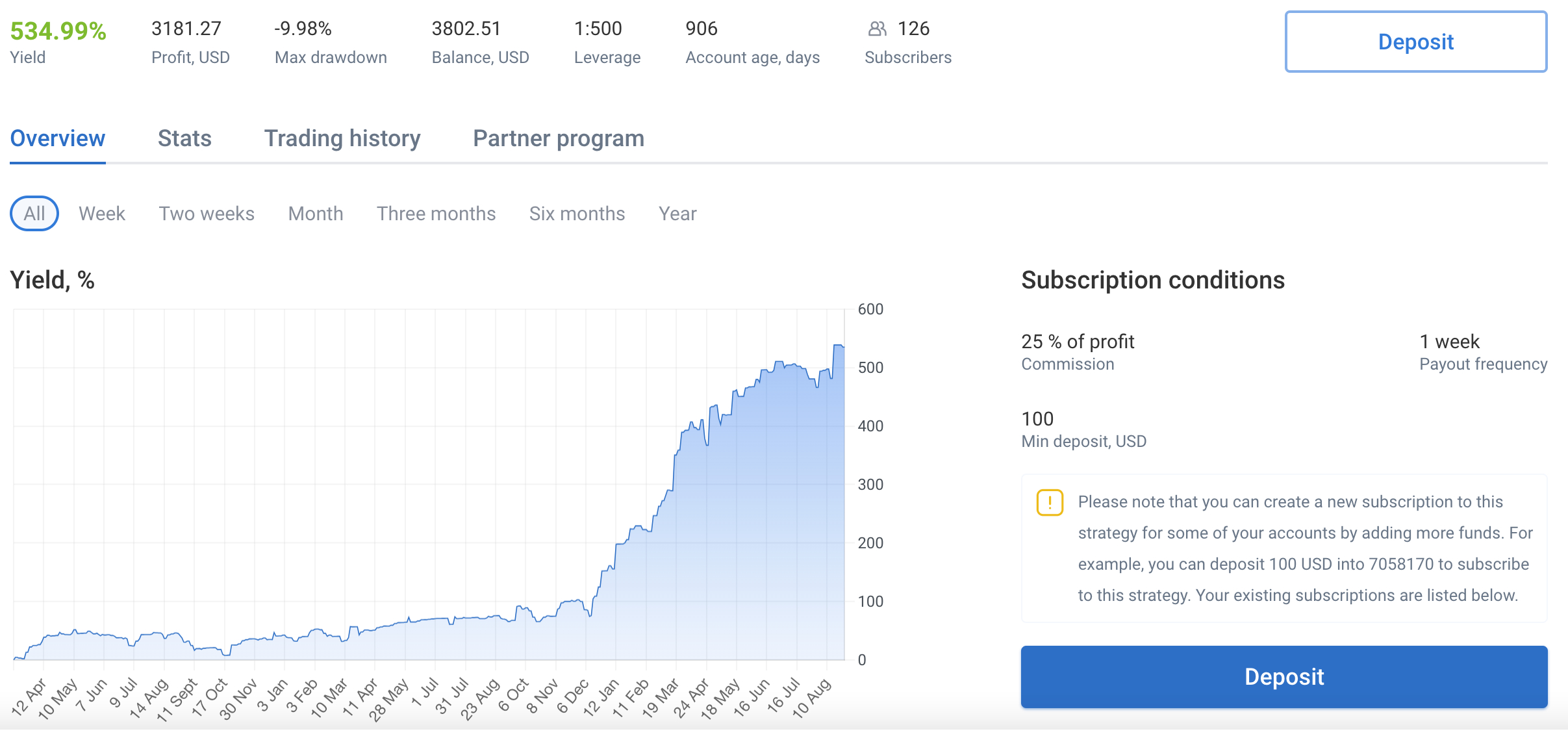
Copy trading has changed the way many people approach the financial markets. Instead of analyzing charts, building trading strategies and placing every order manually, traders can automatically replicate the positions of another trader.
That sounds simple – and technically, it often is. The difficult part is choosing the right copy trading broker and, even more importantly, selecting the right trader or strategy to copy.
A high return alone does not make someone a good trader to follow. A strategy showing 100% profit may have taken enormous risks to achieve it. Another trader may have generated a lower return but maintained controlled drawdowns and consistent risk management over several years.
That is why this comparison of the best copy trading brokers focuses on more than just advertised returns. We look at the copy trading technology, trader selection, transparency, risk management, platform options, costs and overall suitability.
Among the providers worth considering in 2026 are eToro, Pepperstone, AvaTrade, FP Markets and IC Markets. However, they approach copy trading very differently, so the “best” broker depends heavily on what you actually want to copy and how much control you want to retain.

Best Copy Trading Brokers 2026 at a Glance
| Broker | Copy Trading Solution | Platforms | Best For |
|---|---|---|---|
| eToro | CopyTrader | eToro platform | Beginners & investors |
| Pepperstone | CopyTrading, cTrader Copy, Signal Start, MT4 Signals | MT4, MT5, cTrader | Active traders |
| AvaTrade | AvaSocial | AvaSocial, MT4/MT5 | Social trading |
| FP Markets | Social Trading | MT4, MT5 | Forex & CFD traders |
| IC Markets | cTrader Copy | cTrader | Advanced copy traders |
The important point is that these brokers are not identical alternatives. eToro has built copy trading directly into its investment platform, while Pepperstone, FP Markets and IC Markets provide copy trading within a broader trading ecosystem.
What Is Copy Trading?
Copy trading allows you to automatically replicate the trades of another trader.
Instead of deciding yourself when to buy or sell, you select a trader or strategy provider. When that trader opens, modifies or closes a position, the corresponding action is replicated in your account according to the copy settings.
For example, imagine you allocate $1,000 to a strategy provider. The provider opens a position using 5% of their available capital. Depending on the copy model and settings, your account can replicate the trade proportionally.
The important distinction is that you still carry the risk.
If the trader you copy loses money, your account can lose money too. AvaTrade explicitly warns that copying another trader also means taking on that trader’s risk and that past performance does not guarantee future results.
Copy trading therefore isn’t a guaranteed passive-income strategy.
It is better understood as automated execution of another person’s trading decisions.
How Does Copy Trading Work?
The process is generally straightforward:
- Open an account with a broker offering copy trading.
- Deposit funds.
- Browse available traders or strategies.
- Analyze their historical performance and risk.
- Select a trader.
- Decide how much capital to allocate.
- Configure your risk settings.
- Start copying.
- Monitor the strategy regularly.
The technical process can differ considerably between brokers.
With eToro, for example, CopyTrader is integrated directly into the platform. You select an investor, choose the amount you want to allocate and start copying. Trades are then replicated automatically in your portfolio. eToro currently states that the minimum amount required to copy a trader is $200.
Pepperstone takes a different approach. Its CopyTrading solution allows traders to browse thousands of signal providers and copy them through MT4 or MT5. The broker also offers cTrader Copy, Signal Start and MT4 Signals as additional copy-trading options.
This difference is important when choosing a broker.
What Makes the Best Copy Trading Broker?
There is no single feature that determines whether a broker is good for copy trading.
Several factors should be considered.
Regulation and Security
Before looking at trader returns, look at the broker itself.
A broker should be properly regulated for the jurisdiction in which you are opening the account. Regulation does not make trading risk-free, but it provides an important framework around the broker’s activities and client protection.
You should also check:
- Which legal entity will hold your account?
- Which regulator supervises that entity?
- Where are client funds held?
- What investor protection applies?
- Are there restrictions for your country?
- Which products are actually available?
This is particularly important with international brokers because the same brand can operate through different legal entities in different jurisdictions.
Trader Selection
The number of available traders is another important factor.
A platform with only a handful of providers gives you very little choice. A platform with thousands of strategies gives you significantly more possibilities – but also creates another problem: how do you identify the good ones?
eToro, for example, provides thousands of investors that can be copied and displays information including performance and risk-related data. Users can also build a portfolio of multiple copied traders.
The larger selection is useful, but don’t confuse quantity with quality.
Historical Performance
Performance is obviously important.
However, looking only at total return is one of the biggest mistakes a copy trader can make.
Suppose Trader A has generated a 150% return in twelve months.
Trader B has generated 35%.
At first glance, Trader A appears to be the obvious choice.
But now look at the drawdown.
Trader A may have experienced an 80% drawdown before recovering, while Trader B experienced a maximum drawdown of 12%.
Suddenly the comparison looks very different.
When evaluating a strategy, consider:
- Total return
- Monthly performance
- Maximum drawdown
- Average trade
- Win rate
- Risk per trade
- Number of trades
- Trading history
- Average holding time
- Use of leverage
- Open positions
- Losing periods
A smooth equity curve is generally more interesting than a spectacular return produced by extreme risk.
Risk Management Is More Important Than Return
This is probably the most important point in the entire article.
Do not choose a copy trader simply because they are at the top of the performance leaderboard.
Leaderboards can encourage exactly the wrong behavior.
Imagine two traders:
Trader A
- +80% return
- 45% maximum drawdown
- Highly leveraged
- Six months of history
Trader B
- +32% return
- 10% maximum drawdown
- Moderate risk
- Four years of history
For many investors, Trader B may be considerably more attractive.
The objective shouldn’t be to find the trader who made the most money recently.
The objective should be to find a strategy whose risk profile you can actually tolerate.
Some copy trading platforms provide dedicated risk-management features. Pepperstone’s CopyTrading platform, for example, allows users to set parameters such as position sizing and drawdown limits.
That type of control can be much more valuable than another flashy performance statistic.
1. eToro – Best Copy Trading Broker for Beginners
eToro CopyTrader is arguably the most recognizable copy trading platform.
Its major advantage is simplicity.
CopyTrader is built directly into the eToro ecosystem rather than requiring users to connect a separate copy-trading service to a conventional trading account.
Users can search through investors, review their performance and risk information, allocate funds and automatically replicate their trades.
eToro says copied trades are replicated in real time and that there is no additional charge specifically for using CopyTrader, although normal spreads and applicable transaction costs can still apply.
Another interesting feature is the ability to copy multiple investors rather than putting all capital behind one trader. eToro states that users can copy up to 100 traders simultaneously.
Advantages of eToro
- Very simple copy trading interface
- Large selection of investors
- Transparent trader profiles
- Built-in social features
- Virtual portfolio for practice
- Ability to copy multiple traders
- CopyTrader integrated directly into the platform
Disadvantages
The simplicity can also be a disadvantage for experienced traders looking for more traditional broker infrastructure.
The available instruments, fees and account conditions also depend on the user’s jurisdiction.
Best suited for: Beginners and investors who want an easy-to-use copy trading environment.
2. Pepperstone – Best for Experienced Traders
Pepperstone Copy Trading is particularly interesting for traders who already know platforms such as MetaTrader and cTrader.
Pepperstone offers several ways to access copy trading, including its own CopyTrading solution, cTrader Copy, Signal Start and MT4 Signals.
Its own CopyTrading platform allows users to browse thousands of signal providers and connect their MT4 or MT5 account.
The platform also includes risk controls, including position sizing and drawdown limits.
This makes Pepperstone particularly interesting for traders who don’t want to move into a completely different investment platform just to use copy trading.
Advantages of Pepperstone
- Multiple copy trading solutions
- MT4 and MT5 support
- cTrader Copy available
- Large selection of signal providers
- Risk-management controls
- Suitable for active Forex and CFD traders
Disadvantages
The number of different solutions can make the ecosystem slightly more complicated for complete beginners.
Pepperstone also warns that CFDs are complex instruments and that leverage can lead to rapid losses. Its current website displays a retail CFD loss-rate warning of 80% for the relevant entity.
Best suited for: Experienced Forex and CFD traders who want copy trading alongside conventional trading platforms.
3. AvaTrade – Social Trading With AvaSocial
AvaTrade AvaSocial takes a strong social-trading approach.
AvaSocial allows users to discover traders, examine their statistics and performance and then copy their trades.
AvaTrade describes AvaSocial as a community where traders can follow, copy and interact with other traders. Users can also filter traders according to characteristics such as performance, risk level and asset class.
The platform is designed to make copy trading accessible from mobile devices while retaining the ability to monitor and stop copying strategies.
However, availability can depend on jurisdiction. AvaTrade’s help documentation notes regulatory restrictions for certain European users and services.
Therefore, traders should always verify which copy-trading functionality is actually available in their country before opening an account.
Advantages of AvaTrade
- Dedicated AvaSocial platform
- Social trading features
- Trader statistics
- Automated copying
- Mobile-friendly experience
- Established international broker
Disadvantages
- Availability varies by jurisdiction
- Product availability can differ between entities
- Copy trading still carries the full risk of the selected strategy
Best suited for: Traders looking for a dedicated social-trading environment.
4. FP Markets – Copy Trading for MT4 and MT5 Traders
FP Markets Copy Trading offers another interesting option for Forex and CFD traders.
FP Markets Social Trading allows users to browse providers, review their performance and automatically copy selected strategies.
The platform supports multiple copy-trading modes and allows users to copy multiple providers. FP Markets also provides risk-management functionality, including stop-loss and take-profit options through its MT4/MT5 environment.
One of the more useful features is the transparency around provider performance. FP Markets states that potential copiers can review trading history and past performance before selecting a provider.
This is important because choosing a copy trader should involve considerably more research than simply sorting a leaderboard by return.
Advantages of FP Markets
- Copy trading through MT4 and MT5
- Multiple copy modes
- Multiple strategy providers
- Performance and trading history
- Risk-management tools
- Broad range of Forex and CFD markets
Disadvantages
- More traditional trading environment than eToro
- Platform and entity availability varies by country
- CFD trading carries significant risk
Best suited for: Forex and CFD traders who want copy trading within an MT4/MT5 environment.
5. IC Markets – cTrader Copy for Advanced Users
IC Markets cTrader Copy is worth considering for traders who prefer the cTrader ecosystem.
IC Markets provides cTrader Copy, allowing investors to browse strategy providers and automatically mirror their trading strategies.
The platform provides detailed strategy profiles, historical performance information and risk-management tools. It also uses separate copy-trading accounts for followed strategies, which can make monitoring different strategies easier.
This approach is particularly attractive for traders who want more control and analytical information rather than an extremely simplified investment interface.
Advantages of IC Markets
- cTrader Copy integration
- Detailed strategy profiles
- Historical performance data
- Risk-management tools
- Separate copying accounts
- Suitable for experienced traders
Disadvantages
- cTrader can have a steeper learning curve
- Copy trading availability depends on jurisdiction and entity
- Leverage and CFD risks remain substantial
Best suited for: More experienced Forex and CFD traders who want detailed control over their copy-trading setup.
How to Choose a Copy Trader
Choosing the broker is only half the job.
The more important decision is often who you copy.
Don’t start with the question:
“Who made the most money?”
Instead, ask:
“Which strategy has demonstrated the most reasonable risk-adjusted performance?”
Look at the trader’s history.
How Long Has the Trader Been Active?
A trader with three months of exceptional results doesn’t necessarily have a proven strategy.
Ideally, look for a meaningful track record that includes different market conditions.
A strategy that works during a strong bull market may behave very differently during a crash or prolonged sideways market.
What Is the Maximum Drawdown?
Maximum drawdown tells you how far the account historically fell from a previous high.
This is critical.
If you allocate $10,000 to a trader and that trader experiences a 30% drawdown, you could temporarily be down around $3,000 depending on the copying mechanism and execution.
Ask yourself before copying:
Could I psychologically and financially tolerate that drawdown?
If the answer is no, the trader isn’t suitable for you – regardless of their return.
How Much Leverage Is Used?
Leverage can make returns look impressive.
It can also make losses extremely fast.
Be particularly careful with strategies that maintain large positions relative to account equity or repeatedly increase position size after losses.
A strategy that appears highly profitable may actually depend on aggressive risk-taking.
Is Copy Trading Profitable?
It can be profitable.
But there is no guarantee.
Copy trading doesn’t eliminate the fundamental risks of financial markets. It simply transfers the decision-making process from you to another trader.
If the trader is successful, you may benefit.
If the trader loses, you lose as well.
There is also an additional layer of risk: execution differences.
The copied trade may not always be identical to the original trade because of differences in liquidity, spreads, execution speed, account conditions or available instruments.
This is particularly relevant when copying highly active strategies.
Copy Trading vs. Trading Yourself
Which approach is better?
It depends on your objectives.
Trading Yourself
You control:
- Strategy
- Entry
- Exit
- Position size
- Risk
- Timing
The downside is that you need knowledge, experience, time and emotional discipline.
Copy Trading
You outsource the trading decisions to another trader.
The advantages are:
- Less time required
- Automated execution
- Access to established strategies
- Ability to diversify between traders
- No need to manually execute every trade
But you give up direct control over the trading decisions.
For someone who wants to learn trading seriously, copy trading should therefore not necessarily replace education.
It can instead be viewed as a tool that provides exposure to different strategies while you continue learning how professional trading works.
Is Copy Trading Safe?
Copy trading itself is not inherently safe or unsafe.
The risk depends on the broker, the strategy, the markets traded, leverage, position sizing and your own capital allocation.
A regulated broker can reduce certain operational risks, but it cannot prevent a copied strategy from losing money.
This distinction is crucial.
Broker regulation does not mean the trader you copy is profitable.
Likewise, a trader with an impressive historical return is not automatically a safe strategy.
You need to evaluate both sides separately:
1. Is the broker trustworthy and appropriately regulated?
2. Is the strategy suitable for my risk tolerance?
Only when both answers are satisfactory does copy trading become worth considering.
Copy Trading Fees
Copy trading isn’t necessarily free in the broader sense.
A platform may not charge a separate “copying fee”, but other costs can still apply.
Depending on the broker and strategy, you may encounter:
- Spreads
- Commissions
- Overnight financing
- Performance fees
- Platform fees
- Strategy-provider fees
eToro, for example, states that there is no additional fee specifically for using CopyTrader, while normal trading or transaction costs may still apply.
FP Markets also allows strategy providers to set performance fees within its social trading framework, demonstrating why users should always check the exact pricing structure before copying a strategy.
Best Copy Trading Broker: Our Conclusion
There isn’t one universally best copy trading broker for every trader.
The right choice depends on what you want from the platform.
eToro stands out for simplicity and its integrated CopyTrader ecosystem. It is particularly attractive for people who want an easy way to discover and copy investors.
Pepperstone is more appealing to experienced Forex and CFD traders who want copy trading alongside MT4, MT5 or cTrader and access to multiple copy-trading solutions.
AvaTrade offers a dedicated social experience through AvaSocial, although traders need to check availability and regulatory restrictions in their jurisdiction.
FP Markets is an interesting option for traders who want social trading integrated with the MT4/MT5 environment and access to multiple strategy providers.
IC Markets is particularly interesting for more advanced traders who prefer cTrader Copy and want detailed strategy information and risk-management functionality.
Ultimately, the best copy trading broker isn’t the one advertising the highest returns.
It is the broker that provides the right combination of regulation, transparency, execution, platform technology, costs and risk-management tools for your situation.
And even after selecting the broker, the biggest decision remains the trader you copy.
A strategy with a spectacular return but uncontrolled drawdown can be far more dangerous than a strategy producing moderate returns with consistent risk management.
Don’t copy the highest return. Copy a strategy you actually understand and whose risk you can afford.
Overview of Topics