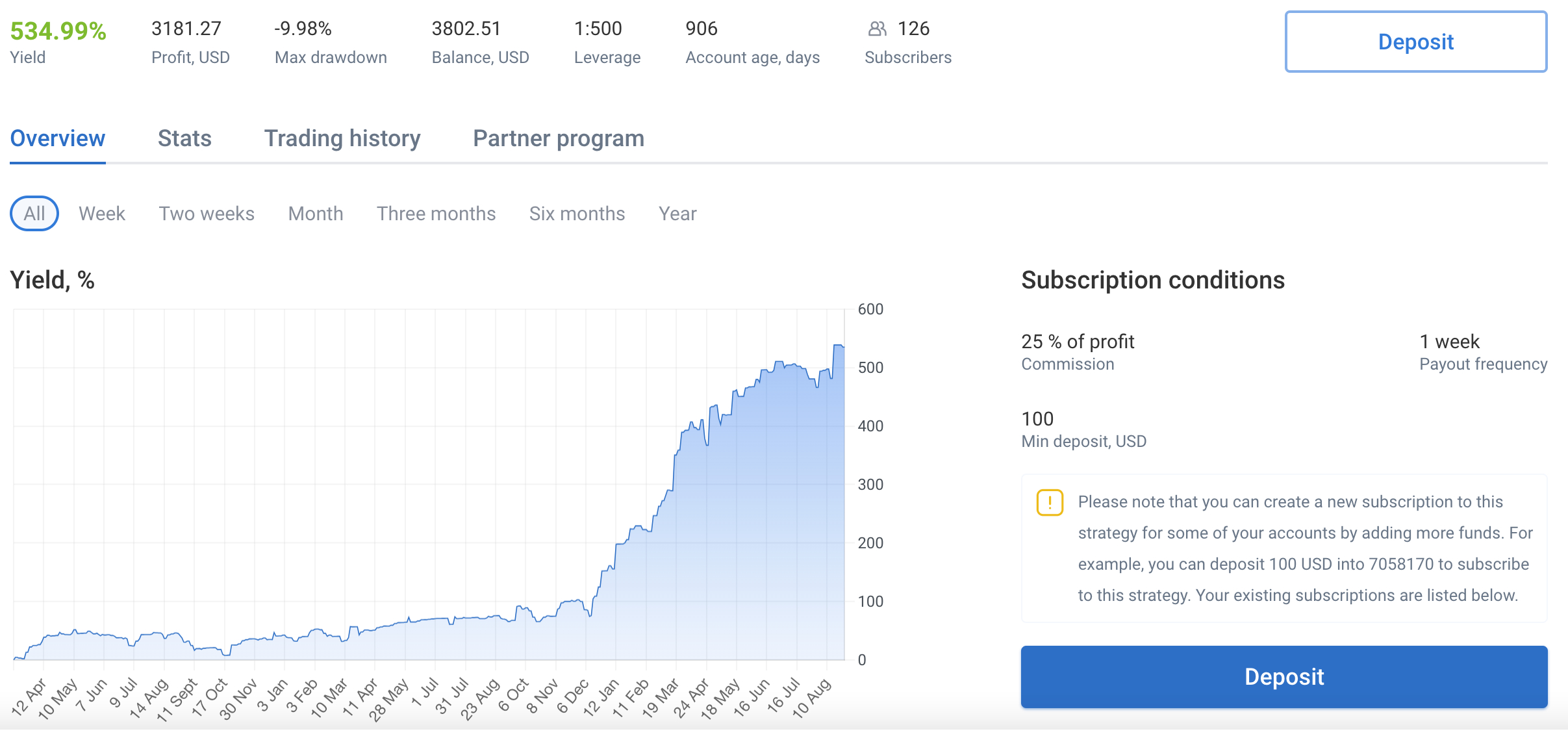
Copy Trading has become an increasingly popular way to participate in the financial markets without making every trading decision yourself.
Instead of analyzing charts, searching for setups and placing orders manually, you can follow another trader and automatically copy their trades.
The concept sounds simple.
But successful Copy Trading involves much more than finding a trader with a high return and clicking “Copy.”
You need to understand how the system works, how much risk is involved, what fees apply and how to evaluate the trader you are following.
Most importantly, past performance does not guarantee future results.
What Is Copy Trading?
Copy Trading is a form of trading where the positions of another trader are automatically replicated in your own trading account.
When the trader you follow opens a position, the same trade can be opened in your account.
When they close the position, your corresponding position can also be closed.
Depending on the platform, the size of the copied trade may be adjusted according to the amount of capital you allocate.
This means you do not necessarily need to decide every entry and exit yourself.
Instead, you select a trader or strategy and allow the platform to replicate their trading activity.
How Does Copy Trading Work?
The process usually starts with a copy trading platform that provides a selection of traders or trading strategies.
You can typically view information about their historical performance and trading behavior.
Depending on the platform, this can include:
Return.
Maximum drawdown.
Number of trades.
Win rate.
Trading history.
Risk score.
Average holding time.
Markets traded.
Once you select a trader, you allocate a certain amount of capital to the strategy.
The platform then automatically replicates the trader’s positions.
The exact mechanism differs between providers, but the principle remains the same:
You choose the strategy. The platform executes the trades for you.
Copy Trading Example
Imagine a trader opens a long position on EUR/USD.
You have allocated €2,000 to copy that trader.
The platform calculates the appropriate position size for your account based on its copy trading rules.
The position is then replicated in your account.
If the original trader closes the position with a profit, your copied trade may also generate a profit.
If the original trader loses money, your account experiences a corresponding loss.
This is important to understand:
Copy Trading does not remove trading risk. It transfers the trading decisions to someone else.
Why Do Traders Use Copy Trading?
One of the biggest advantages is accessibility.
Traditional trading requires traders to learn market analysis, risk management, technical analysis and execution.
Copy Trading can reduce the amount of direct trading knowledge required to execute individual trades.
It can also save time.
A trader does not have to monitor the market constantly or manually enter every position.
This can be particularly attractive to people who have a job, business or other commitments.
Copy Trading for Busy People
Financial markets operate for long periods of the day, depending on the asset class.
Not everyone has the time to sit in front of a chart for several hours.
Copy Trading can automate the execution of another trader’s strategy.
This means the follower does not necessarily have to monitor every market movement.
However, this does not mean that Copy Trading should be completely ignored.
The trader being copied can change their strategy.
Risk can increase.
Market conditions can change.
A strategy that performed well in the past can experience significant losses in the future.
Monitoring remains important.
Copy Trading vs. Manual Trading
Manual trading means that you make your own trading decisions.
You determine when to enter, where to place the stop-loss and when to close the position.
With Copy Trading, another trader makes those decisions.
This creates a fundamental difference.
Manual trading requires more knowledge and time, but gives you greater control.
Copy Trading requires less direct execution but creates dependence on the trader you follow.
Neither approach is automatically better.
The right choice depends on your objectives, experience and risk tolerance.
Copy Trading vs. Automated Trading
Copy Trading is also different from automated trading.
With Copy Trading, you follow the decisions of another trader.
With automated trading, software follows predefined rules or algorithms.
For example, an automated system might be programmed to buy EUR/USD whenever specific technical conditions are met.
Copy Trading does not necessarily require you to understand the underlying algorithm.
You are following another trader’s decisions instead.
What Can You Copy Trade?
The markets available for Copy Trading depend on the platform.
Common markets include:
Forex.
Gold.
Indices.
Stocks.
Commodities.
Cryptocurrencies.
CFDs.
Different markets have very different risk characteristics.
A Forex strategy may behave differently from a cryptocurrency strategy.
A short-term Nasdaq strategy may have a completely different risk profile from a long-term stock strategy.
Always evaluate the market exposure before copying a trader.
Copy Trading Forex
Forex is one of the most common areas for Copy Trading.
Traders can follow strategies that focus on currency pairs such as EUR/USD, GBP/USD or USD/JPY.
Different approaches can be copied, including:
Trend following.
Breakout trading.
Swing trading.
Scalping.
Price action.
Fundamental trading.
Algorithmic strategies.
The important question is not simply which Forex trader has the highest return.
You also need to understand how that return was generated.
Copy Trading Gold
Gold is another popular market among traders.
Gold can experience strong price movements around interest-rate decisions, inflation data, central bank announcements and major economic events.
A trader specializing in gold may therefore have a very different risk profile from a Forex trader.
If you copy such a strategy, you need to understand its volatility and typical drawdowns.
Copy Trading Indices
Indices such as the Nasdaq, S&P 500 or DAX can also be traded through Copy Trading platforms.
Some traders specialize in short-term index strategies.
Others hold positions for several days or weeks.
The holding period is important because it can significantly affect the risk of the strategy.
The Biggest Mistake: Looking Only at Returns
A trader generated 100% last year.
Another generated 25%.
Which one is better?
You cannot answer that question based on returns alone.
The first trader may have experienced a 60% drawdown.
The second may have experienced only a 10% drawdown.
The second strategy may therefore have a much more attractive risk-return profile for many traders.
Return without risk information is incomplete.
Maximum Drawdown
Maximum drawdown is one of the most important statistics when evaluating a Copy Trading strategy.
It measures the largest decline from a previous account peak.
For example, if an account grows from €10,000 to €15,000 and later falls to €12,000, the drawdown from the peak is €3,000, or 20%.
A strategy with large historical drawdowns can be difficult to follow psychologically.
Many followers stop copying a strategy during a losing period, only to miss the potential recovery later.
That is why you should understand the expected drawdown before starting.
Win Rate Is Not Enough
A high win rate does not automatically mean a strategy is profitable.
Consider two systems.
Strategy A wins 80% of trades but has very large losses when it loses.
Strategy B wins only 45% of trades but its average winning trade is significantly larger than its average losing trade.
Strategy B could easily be more profitable.
This is why win rate should always be considered together with average win, average loss and overall expectancy.
Profit Factor
Profit Factor is another useful metric.
It compares the gross profits of a strategy with its gross losses.
For example, if a trader generates $30,000 in gross profits and $15,000 in gross losses, the Profit Factor is 2.0.
This can help provide a clearer picture of the relationship between winning and losing trades.
However, it should not be analyzed in isolation.
Track record length, drawdown, number of trades and trading costs also matter.
How Long Should a Trader Be Tracked?
A short period of strong performance does not necessarily indicate a robust strategy.
A trader who generated 50% in three months may simply have benefited from favorable market conditions.
A longer track record provides more information.
Ideally, you want to see how the strategy behaved during different market environments.
That includes:
Strong trends.
Sideways markets.
High volatility.
Low volatility.
Major economic events.
No amount of historical performance can guarantee future results.
But a larger and more diverse sample can make the evaluation more meaningful.
Trading Costs in Copy Trading
Costs can significantly affect Copy Trading results.
Depending on the platform and account structure, costs may include:
Spreads.
Commissions.
Performance fees.
Management fees.
Overnight financing.
Subscription fees.
Execution costs.
A strategy with frequent trades can be particularly sensitive to spreads and commissions.
Always evaluate performance after costs whenever possible.
Copy Trading and Leverage
Leverage is one of the most important risks to understand.
A trader using high leverage can generate large returns with relatively little capital.
But losses can grow just as quickly.
When you copy a leveraged strategy, you are also exposed to the consequences of that leverage.
A trader who looks highly profitable may simply be taking significantly more risk than another trader.
This is why comparing returns without comparing leverage can lead to misleading conclusions.
Can You Lose Money With Copy Trading?
Absolutely.
Copy Trading does not guarantee profits.
If the trader you follow loses money, your account can also lose money.
There can also be additional risks related to execution, slippage, liquidity and platform functionality.
The amount you lose depends on factors such as your allocation, the strategy’s risk level and how the copying mechanism works.
Never invest money you cannot afford to lose.
Is Copy Trading Passive Income?
Copy Trading is sometimes promoted as passive income.
That description should be treated carefully.
Even though the execution can be automated, the follower still needs to make important decisions.
You have to choose:
Which trader to follow.
How much capital to allocate.
What level of risk is acceptable.
When to stop copying.
Whether the strategy still fits your objectives.
Copy Trading can reduce the amount of manual work involved.
It does not eliminate responsibility.
Copy Trading and Diversification
Some traders choose to follow several different strategies.
The idea is to reduce dependence on a single trader.
This can make sense, but diversification only works when the strategies are genuinely different.
For example, copying five traders who all use aggressive Nasdaq scalping strategies may not provide much diversification.
If the same market conditions cause all five strategies to lose, the portfolio can still experience a significant drawdown.
Look at the underlying markets and trading styles, not just the number of traders.
How to Choose a Copy Trading Strategy
Start with risk, not return.
Ask yourself:
What is the maximum drawdown?
How much leverage does the trader use?
How many trades are opened?
How long are positions held?
Does the trader use stop-losses?
Does the trader average into losing positions?
Is Martingale being used?
How long is the track record?
Are the results independently verifiable?
What fees apply?
These questions can eliminate many unsuitable strategies before you allocate any capital.
Red Flags in Copy Trading
Certain characteristics deserve particular attention.
Extremely high returns over a short period.
Almost no losing trades.
Very high leverage.
Large positions relative to account size.
Frequent averaging down.
Martingale strategies.
A very short track record.
No transparent trading history.
Guaranteed returns.
Claims of easy or risk-free income.
These characteristics do not automatically prove that a strategy is fraudulent.
But they should encourage you to investigate further.
Why Martingale Copy Trading Is Risky
Martingale strategies are particularly important to understand.
A trader increases their position size after a loss in an attempt to recover previous losses with the next winning trade.
The strategy can produce many consecutive winning trades.
That can make the performance look extremely stable.
The problem is what happens during an extended losing streak.
Position sizes can increase dramatically.
Eventually, the strategy may reach a point where the next trade is too large for the available capital.
This can result in a severe drawdown or account failure.
A high win rate should therefore never be viewed as proof that a strategy is low risk.
Copy Trading for Beginners
Copy Trading can be attractive to beginners because it reduces the need to execute trades manually.
But beginners should not use Copy Trading as a replacement for learning how financial markets work.
You should understand at least the basics of:
Risk management.
Leverage.
Drawdown.
Position sizing.
Trading costs.
Market volatility.
A trader who understands these concepts is in a much better position to evaluate the strategies being copied.
Copy Trading for Experienced Traders
Experienced traders can use Copy Trading in a different way.
Instead of simply following a strategy, they can use it as part of a broader portfolio.
For example, a trader may allocate a small portion of their capital to external strategies while managing the rest independently.
This allows them to diversify their exposure to different trading approaches.
However, the same risk principles still apply.
How Much Should You Allocate to Copy Trading?
There is no universal percentage that is appropriate for everyone.
The amount depends on your financial situation, risk tolerance and overall portfolio.
The important principle is simple:
Do not allocate more capital than you can afford to lose.
If a strategy experiences a significant drawdown, you need to be financially and psychologically prepared to handle it.
Does Copy Trading Actually Work?
Copy Trading can work.
There are traders and strategies that have generated positive returns over long periods.
But there are also many strategies that fail.
The technology itself does not create profitability.
The quality of the underlying trading strategy remains the most important factor.
Successful Copy Trading therefore requires selection, risk management and ongoing evaluation.
The Future of Copy Trading
Copy Trading is likely to remain an important part of the trading ecosystem.
Technology makes it increasingly easy to discover strategies, compare traders and automatically replicate positions.
At the same time, greater accessibility also means that traders need to become better at evaluating risk.
The future is unlikely to belong simply to the trader with the highest monthly return.
It will favor platforms and strategies that provide transparency, robust risk management and verifiable performance.
Conclusion: Is Copy Trading Worth It?
Copy Trading can be an interesting alternative for people who want exposure to financial markets without manually executing every trade.
It can save time, simplify execution and provide access to different trading strategies.
But it does not eliminate risk.
The trader you copy can lose money.
Markets can change.
Drawdowns can become significant.
Leverage can amplify losses.
And past performance does not guarantee future results.
The key is therefore not to search for the trader with the biggest return.
Instead, evaluate the complete picture:
Track record. Risk. Drawdown. Strategy. Leverage. Costs. Transparency.
Copy Trading works best when it is treated as a serious investment decision rather than a shortcut to easy money.
Don’t copy blindly. Understand the strategy, understand the risk and make your own informed decision.
Overview of Topics