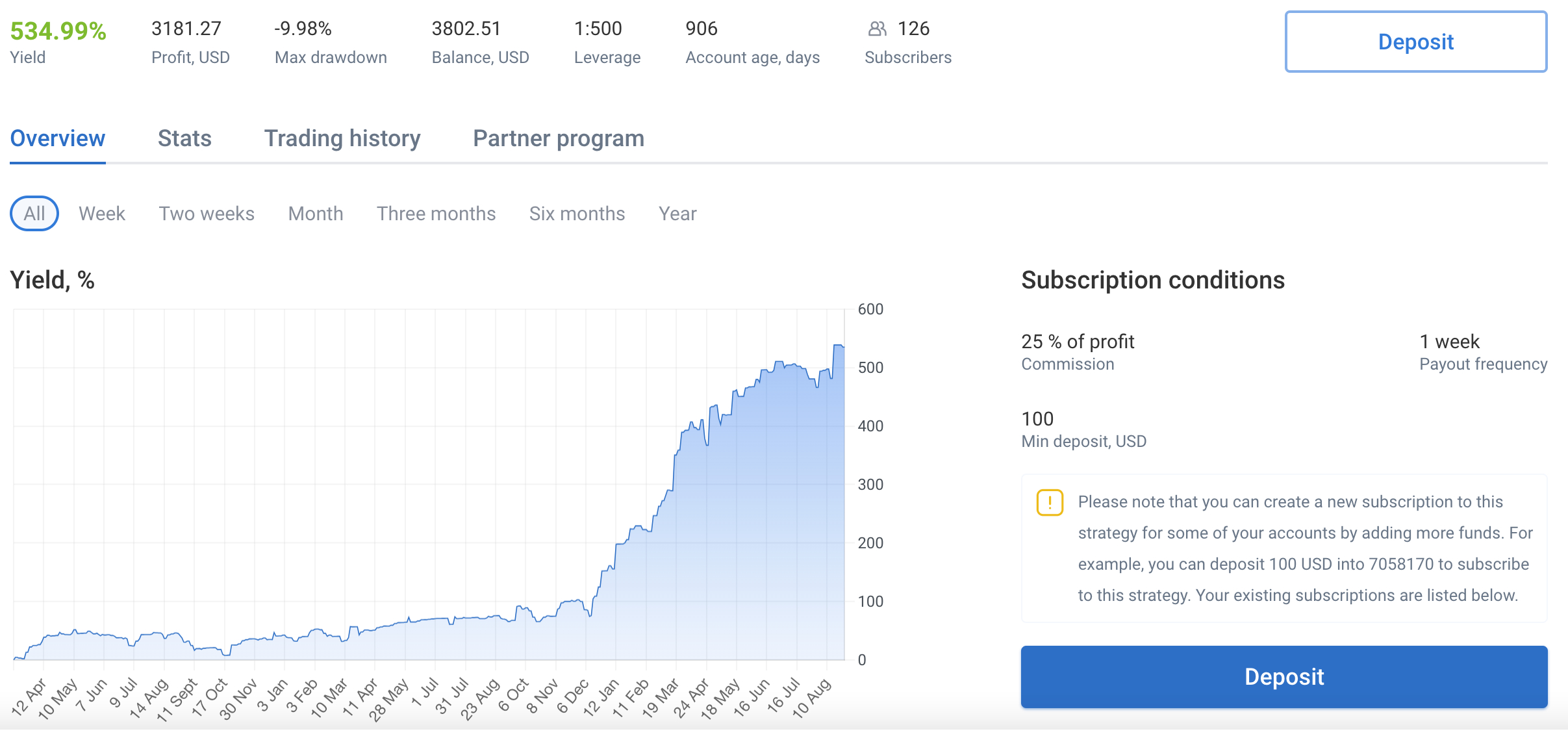
Finding professional traders to copy sounds straightforward. Most copy trading platforms provide leaderboards where you can sort traders by return, number of followers or popularity.
But a high return does not automatically mean that you are looking at a professional trader.
A trader can generate an impressive percentage return over a few weeks while taking enormous risks. Another trader might generate more moderate returns over several years with disciplined position sizing, controlled drawdown and a consistent strategy.
For anyone considering copy trading, the second profile may be considerably more interesting.
The real challenge is therefore not simply finding a trader who made money.
It is finding a trader whose experience, strategy, risk management and historical performance suggest a disciplined approach to trading.
This guide explains what to look for when searching for professional traders to copy and how to evaluate them beyond simple leaderboard rankings.
What Is a Professional Trader?
There is no universal definition of a “professional trader” across every copy trading platform.
The term can refer to different things.
A professional trader might be someone who:
- Trades financial markets as their primary occupation
- Has several years of experience
- Manages significant capital
- Trades for a financial institution
- Manages money for clients
- Operates a professional trading business
- Has developed a systematic trading strategy
However, a trader does not necessarily need to work for a bank or investment fund to demonstrate professional trading behavior.
For copy trading, professionalism is often more useful as a description of how someone trades than what their job title says.
A disciplined independent trader with a transparent five-year track record may be more interesting to copy than someone calling themselves a professional trader on social media.
Professional Trader Does Not Mean Guaranteed Profits
This distinction is essential.
Even a highly experienced trader can lose money.
Markets are unpredictable, and no strategy works under every market condition.
A professional approach generally means that the trader understands and manages risk rather than eliminating it.
Therefore, don’t look for a trader who claims:
- Guaranteed profits
- No losing trades
- Risk-free returns
- Guaranteed monthly income
- Consistent double-digit returns without drawdowns
These claims should immediately raise questions.
A genuine professional understands that losses are part of trading.
Why Professional Traders Can Be Attractive for Copy Trading
Copy trading allows you to replicate another trader’s positions without manually executing every trade.
This can be useful if you don’t have:
- Time to monitor markets
- Experience with technical analysis
- A defined trading strategy
- The ability to trade consistently
Instead of making every decision yourself, you can follow a trader whose strategy matches your objectives.
However, copying a professional-looking trader doesn’t remove the need for due diligence.
You still need to understand what you’re copying.
How to Find Professional Traders to Copy
The first step is to use the information available on the copy trading platform.
Look for traders with:
- Long track records
- Transparent trading histories
- Verified performance
- Controlled drawdowns
- Consistent results
- Clear strategies
- Reasonable leverage
- Disciplined position sizing
Don’t start with the highest return.
Start with quality and transparency.
Look for a Long Track Record
Experience cannot be proven by a trader’s biography alone.
A much more useful indicator is the trading history.
Compare:
Trader A
4 months of history
+85% return
Trader B
5 years of history
+62% return
Trader A has the higher return.
But Trader B provides considerably more historical information.
A five-year track record allows you to analyze how the strategy behaved through multiple market environments.
That’s valuable when evaluating professional traders to copy.
Analyze Verified Performance
Where available, look for verified trading accounts.
Verification can provide evidence that the displayed performance comes from actual trading activity rather than screenshots or manually reported results.
Useful information may include:
- Account history
- Balance
- Equity
- Returns
- Drawdown
- Open positions
- Trade history
However, verification does not mean that a trader is guaranteed to remain profitable.
It simply provides greater transparency about historical activity.
Check Maximum Drawdown
Professional trading isn’t just about making money.
It’s also about controlling losses.
Maximum drawdown shows the largest historical decline from a peak in account value to a subsequent low.
Consider:
Trader A
Return: +100%
Maximum drawdown: -45%
Trader B
Return: +55%
Maximum drawdown: -10%
Trader A generated significantly more profit.
But the strategy also experienced a much larger historical loss.
Depending on your risk tolerance, Trader B could be a more appropriate trader to copy.
Look at Risk-Adjusted Performance
Returns should always be considered alongside risk.
Useful metrics can include:
- Maximum drawdown
- Sharpe ratio
- Sortino ratio
- Calmar ratio
- Profit factor
- Recovery factor
Not every platform provides all of these statistics.
But the principle is simple:
Don’t ask only how much the trader made. Ask how much risk they took to make it.
Consistency Is More Important Than One Big Win
A professional trader doesn’t necessarily make money every month.
Losing months are normal.
What matters is the overall pattern.
Imagine:
Trader A
+20%
-18%
+45%
-22%
+35%
Trader B
+4%
+5%
-2%
+6%
+3%
+5%
Trader A may have generated a higher total return.
But Trader B demonstrates much lower volatility.
Which trader is better?
That depends on your objectives.
The important point is that the performance profile tells you more than a single return figure.
Analyze the Worst Months
One of the best ways to understand a trader is to examine their worst periods.
Ask:
- How large was the loss?
- How long did it last?
- How did the trader recover?
- Did position sizes increase?
- Did the trader change strategy?
- Did leverage increase?
The worst period can reveal weaknesses that aren’t visible during profitable periods.
Look at Leverage
Leverage deserves particular attention when evaluating Forex and CFD traders.
A trader can generate high returns simply by taking very large leveraged positions.
That doesn’t necessarily indicate superior trading ability.
For example:
Trader A
+50% return
Moderate leverage
Trader B
+50% return
Very high leverage
The return is identical.
The risk isn’t.
Professional traders generally understand that leverage is a tool that must be controlled.
When copying someone, you need to understand how much leverage their strategy typically uses.
Examine Position Sizing
Position sizing is another important indicator of trading discipline.
Look for consistency.
If a trader normally risks a similar amount on each trade, the strategy may be more systematic.
If position sizes suddenly increase after losses, investigate further.
This could indicate:
- Martingale
- Recovery trading
- Aggressive averaging
- Emotional decision-making
Large changes in position size can dramatically alter the risk profile.
Watch for Martingale
Martingale strategies are particularly important to identify.
A trader increases the size of subsequent positions after losses in an attempt to recover previous losses.
For example:
- €100
- €200
- €400
- €800
- €1,600
The strategy can generate a very high percentage of winning trades.
But one extended losing sequence can cause significant losses.
A trader using martingale may therefore appear extremely successful until market conditions move against the strategy.
Don’t assume a high win rate equals professional risk management.
Understand the Trader’s Strategy
Before copying a trader, you should understand their basic approach.
Possible strategies include:
Trend Following
The trader attempts to capture sustained market movements.
Swing Trading
Positions are typically held for several days or longer.
Day Trading
Positions are generally opened and closed within the same trading day.
Scalping
Trades may last seconds or minutes.
Breakout Trading
The trader attempts to capture moves following a break through important price levels.
Mean Reversion
The trader expects prices to move back toward an average or range.
Algorithmic Trading
Trading decisions are partially or fully automated.
Understanding the strategy helps you evaluate whether the historical performance is likely to be dependent on specific market conditions.
Professional Traders Don’t Need to Win Every Trade
A common misconception is that professional traders have extremely high win rates.
That’s not necessarily true.
Consider a strategy with:
- 40% winning trades
- 60% losing trades
- Average winner: €500
- Average loser: €200
The trader can still be profitable.
The key is the relationship between winning and losing trades.
This is why you should look at:
- Win rate
- Average win
- Average loss
- Profit factor
rather than focusing on win rate alone.
Check Profit Factor
Profit factor is calculated as:
Gross profits ÷ gross losses
For example:
Gross profits: €20,000
Gross losses: €10,000
Profit factor:
2.0
This means the strategy generated €2 of gross profit for every €1 of gross loss during the measured period.
A higher profit factor can be attractive, but it needs to be considered alongside the track record and drawdown.
A very high number over a short period isn’t necessarily meaningful.
Look at Current Positions
Historical performance tells you what happened.
Current positions tell you what is happening now.
Suppose a trader has generated:
+75% over two years
But currently has a large leveraged position that represents a significant portion of the account.
The historical return doesn’t fully describe the current risk.
Where the platform provides the information, check:
- Open positions
- Position sizes
- Floating profit/loss
- Margin usage
- Current drawdown
- Market concentration
Professional Traders and Risk Management
Risk management is one of the most important characteristics to look for.
A disciplined trader should have some form of framework around:
- Position sizing
- Stop losses
- Maximum exposure
- Leverage
- Drawdown
- Portfolio risk
The exact method varies.
Some professional traders use tight stop losses.
Others may use wider stops with smaller position sizes.
The specific technique matters less than whether the risk is intentional and controlled.
Stop Losses Aren’t Everything
Don’t assume that a trader is automatically professional simply because every trade has a stop loss.
Some strategies use portfolio-level risk management instead.
Others may hedge positions.
Some systematic strategies have predefined exit rules without conventional stop losses.
The important question is:
How does the trader control downside risk?
Look at the actual historical behavior rather than relying on one feature.
Professional Traders to Copy and Diversification
Copying several traders can potentially diversify your portfolio.
For example:
- One Forex trend-following trader
- One gold trader
- One index trader
- One lower-frequency swing trader
But diversification only works if the strategies are genuinely different.
If all traders are long the same markets, they may all lose money at the same time.
Therefore, examine:
- Markets traded
- Strategy
- Directional exposure
- Trading timeframe
- Correlation
More traders do not automatically mean less risk.
How Many Traders Should You Copy?
There is no universal number.
Copying one trader gives you concentrated strategy risk.
Copying many traders can create unnecessary complexity and overlapping exposure.
The appropriate number depends on:
- Account size
- Risk tolerance
- Strategy differences
- Market exposure
- Platform capabilities
The goal should be meaningful diversification, not simply a large number of copied accounts.
Professional Traders vs. Popular Traders
Popularity is not the same as professionalism.
A trader with:
50,000 followers
isn’t necessarily better than one with:
500 followers.
Follower counts can be influenced by:
- Marketing
- Social media presence
- High recent returns
- Platform rankings
- Aggressive trading
Instead of asking how many people follow the trader, ask:
Does the trader have a transparent and sustainable performance history?
Don’t Rely on Social Media
Social media can be useful for discovering traders.
But it is a poor substitute for verified account data.
A social media profile might show:
- Winning trades
- Profit screenshots
- Luxury purchases
- Testimonials
- Lifestyle content
None of these prove long-term trading performance.
Whenever possible, evaluate the actual trading account rather than the trader’s marketing.
Professional Traders and CFD Copy Trading
Many copy trading services use CFDs.
This can provide access to:
- Forex
- Indices
- Gold
- Commodities
- Shares
But CFDs are leveraged derivatives.
That means the risk can be significantly higher than simply holding an unleveraged asset.
When copying CFD traders, pay particular attention to:
- Leverage
- Margin
- Financing costs
- Drawdown
- Position size
- Overnight exposure
The trader’s return should always be evaluated in the context of the leverage used.
Check Trading Costs
Your actual return may differ from the trader’s published performance.
Potential costs include:
- Spreads
- Commissions
- Overnight financing
- Currency conversion
- Platform fees
- Performance fees
Scalping strategies can be particularly sensitive to spreads and execution costs.
Longer-term strategies may be more affected by overnight financing.
Always consider the costs that apply to your own account.
Slippage Can Affect Copy Trading Results
Slippage occurs when a trade executes at a different price than expected.
This can happen during periods of high volatility or low liquidity.
In copy trading, there may also be a small delay between the trader’s execution and the copied execution.
This can create differences in:
- Entry price
- Exit price
- Profit
- Loss
The difference may be relatively small for longer-term trades but more significant for short-term strategies.
How to Evaluate Professional Traders to Copy
A useful process is to score traders based on several categories.
For example:
| Factor | Trader A | Trader B | Trader C |
|---|---|---|---|
| Track Record | 4 years | 2 years | 6 months |
| Return | 70% | 45% | 130% |
| Max Drawdown | 12% | 8% | 48% |
| Leverage | Moderate | Low | Very High |
| Consistency | High | High | Low |
| Strategy | Swing | Trend | Grid |
| Risk Level | Moderate | Low | Very High |
Trader C has the highest return.
But Trader B may have the strongest combination of consistency and risk control.
This is why professional traders to copy should be evaluated holistically.
A Practical Selection Process
Step 1: Define Your Risk Tolerance
Before looking at traders, determine how much drawdown you can tolerate.
Step 2: Filter for Track Record
Remove traders with extremely short histories.
Step 3: Check Verification
Prefer transparent, independently verifiable performance data.
Step 4: Compare Return and Drawdown
Don’t evaluate return without risk.
Step 5: Analyze Strategy
Understand how the trader generates returns.
Step 6: Check Leverage
Look for excessive exposure.
Step 7: Analyze Position Sizing
Check whether positions remain controlled.
Step 8: Investigate Losing Periods
Study the worst historical drawdowns.
Step 9: Check Current Exposure
Understand what you would be copying today.
Step 10: Compare Several Traders
Avoid making your decision based on one leaderboard ranking.
Questions to Ask Before Copying a Professional Trader
Before allocating capital, ask:
How long has the trader been active?
Is the trading account verified?
What is the maximum drawdown?
How long did previous drawdowns last?
What is the average monthly return?
What is the worst month?
How much leverage is used?
What markets are traded?
How large are positions?
Does the trader use martingale?
Does the trader average into losing positions?
What is the current exposure?
What are the trading costs?
These questions can reveal much more than a simple return ranking.
Red Flags When Looking for Professional Traders
Be cautious when you see:
- Guaranteed returns
- “No-loss” strategies
- Extremely high monthly returns
- Huge returns with minimal drawdown
- Very short track records
- Extreme leverage
- Rapidly increasing position sizes
- Martingale
- Aggressive averaging
- Large floating losses
- Lack of transparent trading history
- Heavy reliance on screenshots
The more extraordinary the performance looks, the more carefully you should investigate the underlying risk.
Can Professional Traders Guarantee Profits?
No.
There is no legitimate trader who can guarantee future trading profits.
Markets can change.
Strategies can stop working.
Unexpected events can create losses.
Even experienced professional traders experience losing periods.
The objective of due diligence is therefore not to find someone who never loses.
It’s to identify a trader whose historical approach to risk and performance fits your own expectations.
What Makes a Trader Worth Copying?
A potentially attractive professional trader profile could include:
- Several years of verified history
- Consistent performance
- Moderate drawdown
- Controlled leverage
- Transparent strategy
- Disciplined position sizing
- No obvious martingale behavior
- Clear risk management
- Reasonable trading costs
- Stable performance across different market conditions
None of these characteristics guarantees future performance.
But together they can provide a stronger basis for evaluation.
Professional Traders to Copy: The Bottom Line
Finding professional traders to copy isn’t about finding the trader with the highest return on a leaderboard.
It is about identifying traders who demonstrate experience, consistency, transparency and disciplined risk management.
Start with the track record.
Then examine maximum drawdown, monthly performance, leverage, position sizing, strategy and current exposure. Pay particular attention to what happens during losing periods.
A professional trader doesn’t need to win every trade.
They don’t need to produce spectacular monthly returns.
And they certainly don’t need to promise guaranteed profits.
Instead, look for a trader whose historical results were achieved through a process you can understand and whose risk profile you can realistically tolerate.
Remember that copy trading does not remove market risk. It simply automates the execution of another trader’s decisions.
The most important question is therefore not:
“Which trader made the most money?”
It is:
“Which trader has demonstrated a trading approach that I understand, whose risk I can tolerate and whose historical performance is transparent enough to evaluate?”
That is a much more useful starting point when looking for professional traders to copy.
Overview of Topics