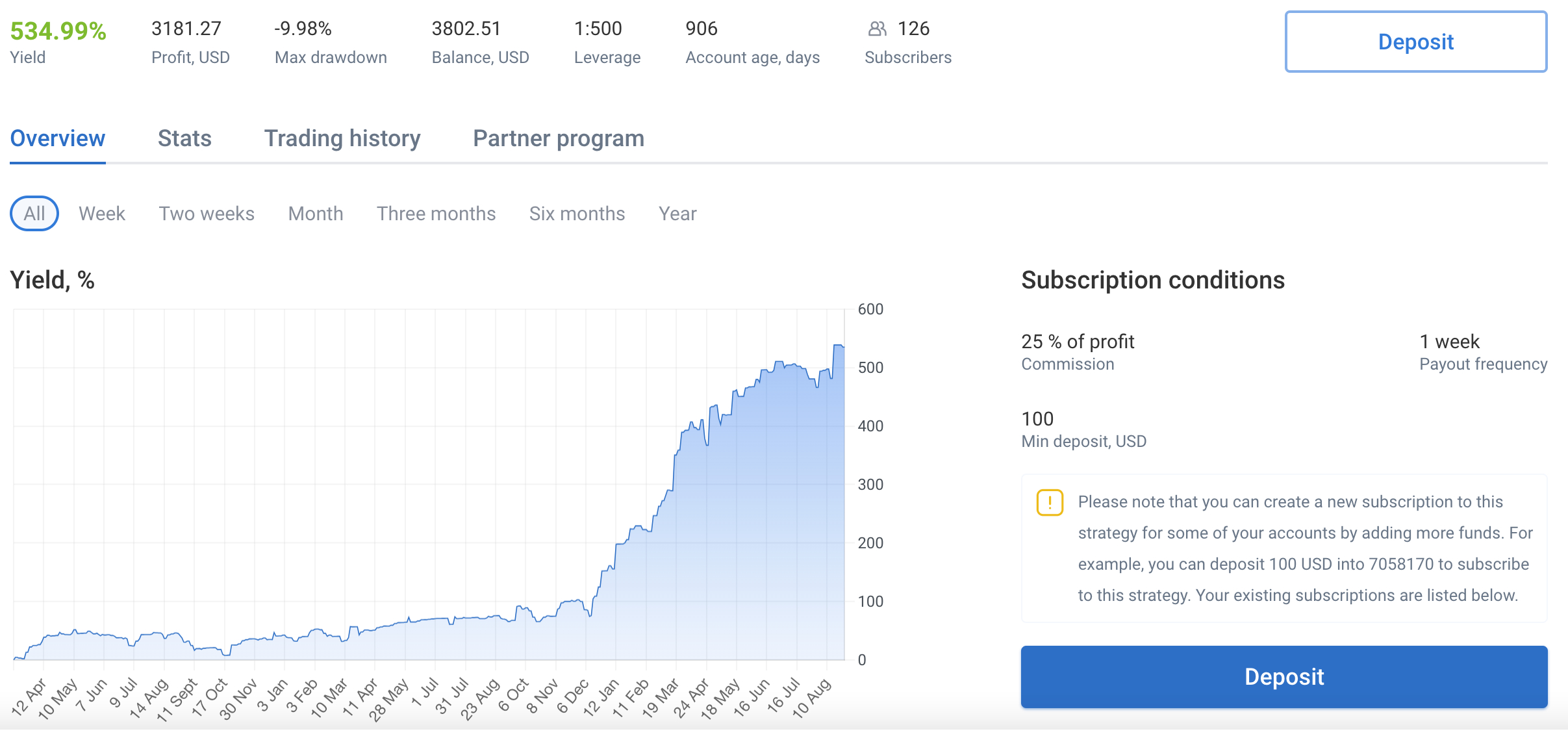
Is copy trading profitable? Yes, copy trading can be profitable, but there is no guarantee that you will make money.
That distinction is important.
Copy trading allows you to automatically replicate the trades of another trader. If the strategy you copy generates profits, your account may also generate profits. But if the trader loses money, your account can lose money as well.
The fact that a trader has generated strong returns in the past does not mean that the same performance will continue in the future.
This is one of the biggest misconceptions surrounding copy trading. Some platforms make it very easy to find traders with impressive historical returns. A strategy showing +100%, +200% or even more can look extremely attractive at first glance.
But the return alone tells you very little.
The more important questions are:
- How much risk was taken to generate that return?
- What was the maximum drawdown?
- How long has the trader been active?
- Does the strategy use leverage?
- How consistent has the performance been?
- What happens when market conditions change?
- Are fees and trading costs included in the performance?
A trader generating 30% with controlled risk may be considerably more attractive than a trader generating 100% with extreme leverage.
Therefore, the real question isn’t simply whether copy trading is profitable.
It is whether you can identify a strategy with a reasonable risk-to-return profile and manage your own capital appropriately.
How Does Copy Trading Generate Profits?
Copy trading doesn’t generate profits independently.
The underlying strategy generates the potential return.
Imagine that you allocate $5,000 to a trader.
The trader buys an asset and the market moves in their favor. The position generates a profit, and the copy trading platform replicates the trade in your account.
If the copied position generates a 5% return on your allocated capital, you could theoretically make approximately $250 before costs and other differences in execution.
But the opposite is also true.
If the strategy loses 5%, you could lose approximately $250.
The important point is that your results are linked to the performance of the strategy you copy.
Your actual result can also differ from the provider’s published performance because of:
- Different account sizes
- Spreads
- Commissions
- Slippage
- Execution timing
- Financing costs
- Platform fees
- Performance fees
Therefore, published strategy returns should always be treated as historical information rather than a promise of future performance.
How Much Money Can You Make With Copy Trading?
There is no fixed answer.
Anyone claiming that copy trading produces a specific monthly return is oversimplifying the reality of financial markets.
Your potential return depends on several factors:
- The trader you copy
- The strategy used
- Your capital allocation
- Market conditions
- Leverage
- Trading costs
- Execution
- Risk management
For example, suppose you allocate $10,000 to a strategy.
If the strategy gains 10% during a particular period, you could theoretically make approximately $1,000 before costs.
If it loses 10%, you could lose approximately $1,000.
This example demonstrates why percentage returns should always be considered together with risk.
A strategy returning 10% isn’t necessarily better than another returning 5%.
If the first strategy required a 40% drawdown to achieve its return while the second experienced only a 5% drawdown, the second may be much more attractive for a risk-conscious investor.
Can You Make Consistent Profits With Copy Trading?
Consistent profits are possible, but consistent returns are not guaranteed.
Financial markets don’t move in a straight line.
Even professional traders experience losing trades and losing periods.
A strategy can be profitable over several years while still experiencing:
- Losing weeks
- Losing months
- Drawdowns
- Losing streaks
- Periods of low activity
This is completely normal.
The important question is whether the strategy has demonstrated that it can recover from difficult periods without taking excessive additional risk.
You should therefore avoid evaluating a trader based on a few profitable weeks.
A longer track record provides much more useful information.
Why High Returns Can Be Misleading
One of the biggest problems with copy trading platforms is that high returns are highly visible.
Imagine a platform shows the following traders:
Trader A: +150%
Trader B: +75%
Trader C: +32%
At first glance, Trader A looks like the obvious choice.
But now look at the maximum drawdowns:
Trader A: -65%
Trader B: -25%
Trader C: -8%
The picture changes completely.
Trader A generated the highest return, but investors also had to tolerate a massive decline.
If you cannot psychologically tolerate losing 30%, 40% or 50% of your allocated capital, a strategy with that historical drawdown probably isn’t suitable for you.
This is why professional analysis should focus on risk-adjusted performance, not simply raw returns.
What Is Drawdown in Copy Trading?
Drawdown measures how far an account or strategy falls from a previous high.
For example:
You allocate $10,000.
The strategy grows to $12,000.
The account then falls to $10,800.
The drawdown from the peak is $1,200, or 10%.
The strategy could still eventually recover and reach new highs.
But you need to be prepared to experience that decline while copying it.
This is particularly important because many people stop copying a strategy during a drawdown.
They see their account falling and assume the strategy has stopped working.
If they stop at the bottom and the strategy subsequently recovers, they may miss the recovery.
At the same time, you shouldn’t blindly hold a strategy simply because you hope it will recover.
The key is determining beforehand what level of risk you are willing to accept.
Is Copy Trading Safer Than Trading Yourself?
Not necessarily.
Copy trading can reduce the amount of manual decision-making required, but it doesn’t eliminate market risk.
When trading manually, you are responsible for your own decisions.
With copy trading, you are relying on someone else’s decisions.
This introduces a different type of risk.
For example, you may not know exactly why the trader opened a particular position.
You may also not know when their strategy will change.
A trader who previously used moderate leverage might suddenly increase their position sizes.
If you continue copying automatically, that increased risk can also appear in your account.
Copy trading should therefore never be confused with professional portfolio management or a guaranteed investment product.
Is Copy Trading Profitable for Beginners?
Copy trading can potentially be profitable for beginners, but beginners face the same market risks as experienced traders.
The advantage is that you don’t have to execute every trade manually.
However, you still need to make several important decisions:
- Which broker should you use?
- Which trader should you copy?
- How much money should you allocate?
- How much drawdown can you tolerate?
- How many traders should you follow?
- When should you stop copying?
Without understanding these decisions, copy trading can become little more than blindly following a leaderboard.
A beginner who understands risk management can potentially use copy trading more responsibly than an experienced trader who chooses strategies based solely on short-term returns.
What Makes a Profitable Copy Trading Strategy?
There is no strategy that will remain profitable forever.
However, some characteristics can make a strategy easier to evaluate.
Long Track Record
A trader with several years of history gives you more data than someone who started three months ago.
Controlled Drawdown
Lower drawdowns don’t guarantee profitability, but they can indicate a more conservative risk profile.
Consistent Performance
Look at performance across different periods rather than focusing on one exceptional month.
Reasonable Leverage
Aggressive leverage can increase both profits and losses.
Transparent Trading History
You should be able to understand what the trader has actually been doing.
Clear Strategy
You should have at least a basic understanding of the trader’s approach.
If you don’t understand the strategy at all, it becomes much harder to recognize when something changes.
Does More Capital Mean More Profit?
Not necessarily.
More capital means that the same percentage return results in a larger monetary gain.
For example:
$1,000 × 10% = $100
$10,000 × 10% = $1,000
$100,000 × 10% = $10,000
But the percentage return remains the same.
The opposite is also true.
A 10% loss on $100,000 is $10,000.
This is why increasing your copy trading allocation doesn’t make the strategy better.
It simply increases the monetary impact of both profits and losses.
Can You Lose All Your Money With Copy Trading?
Depending on the instruments, leverage and trading strategy, substantial losses can occur.
The exact risks depend on the broker, product and account structure.
Leveraged CFD and Forex strategies can be particularly risky because relatively small market movements can have a large impact on account equity.
Some traders may also use aggressive strategies that significantly increase downside risk.
This is why risk management should be considered before copying a strategy rather than after losses have already occurred.
How Important Is Leverage?
Leverage is one of the most important factors to check.
Suppose two traders both generate a 30% return.
Trader A uses moderate leverage.
Trader B uses very high leverage.
Their historical return may look identical, but their risk profiles can be completely different.
Trader B could potentially experience much larger losses during an adverse market movement.
High leverage can also make a strategy’s equity curve appear extremely attractive during favorable conditions.
But the same leverage can accelerate losses when the market moves against the position.
When evaluating a copy trader, always ask how the returns were generated.
What Fees Can Reduce Copy Trading Profits?
Your gross return isn’t necessarily your final return.
Depending on the platform, you may pay:
Spreads
The difference between the bid and ask price.
Commissions
Some brokers charge commissions on certain trades.
Overnight Financing
Holding leveraged positions overnight can result in financing charges.
Performance Fees
Some copy trading strategies charge a percentage of profits.
Platform Fees
Certain providers may charge additional fees for access to specific strategies.
These costs can have a significant impact on active strategies with a high number of transactions.
A trader’s historical performance should therefore be evaluated together with the costs involved in replicating the strategy.
How to Identify a Potentially Good Copy Trader
If profitability is your objective, don’t simply sort traders by return.
Instead, build a complete profile.
Look at:
Performance: How much has the strategy historically returned?
Drawdown: How much did the strategy lose from peak to trough?
Track record: How long has it been active?
Risk: How aggressive is the strategy?
Leverage: How much leverage is typically used?
Consistency: Are returns spread over time?
Trading style: Does the strategy match your objectives?
Transparency: Can you understand what the trader is doing?
This approach gives you considerably more information than a single percentage.
Should You Copy One Trader or Several?
Copying multiple traders can potentially reduce dependence on a single strategy.
For example, you could combine:
- Forex
- Gold
- Indices
- Stocks
- Different trading timeframes
However, diversification doesn’t automatically reduce risk.
If multiple traders use similar strategies or trade the same instruments, they can all lose money simultaneously.
Therefore, look at the underlying strategies rather than simply the number of traders.
Can Copy Trading Be Passive Income?
Copy trading is sometimes marketed as passive income.
That description can be misleading.
Although trade execution can be automated, your capital remains exposed to market risk.
You still need to:
- Select strategies
- Monitor performance
- Review drawdown
- Check risk
- Evaluate changes
- Manage your allocation
A copy trading account should therefore not be treated like a savings account generating predictable interest.
The returns can fluctuate significantly, and losses are possible.
Copy Trading vs. Traditional Investing
Copy trading is different from traditional long-term investing.
When you invest in a diversified portfolio of stocks or ETFs, you may hold assets for years.
Copy trading can involve much more active strategies.
A copied trader might execute dozens or hundreds of trades per month, depending on their approach.
This can create:
- Higher trading costs
- More frequent exposure
- Greater short-term volatility
- Greater dependence on the strategy provider
Therefore, you should understand whether your objective is long-term investing or active trading before choosing copy trading.
Is Copy Trading Worth It?
Whether copy trading is worth it depends on your objectives and expectations.
It may be interesting if:
- You don’t have time to trade manually
- You want to follow established strategies
- You understand the risks
- You are comfortable with variable returns
- You are prepared to monitor your allocation
It may not be suitable if you:
- Expect guaranteed monthly income
- Cannot tolerate losses
- Choose traders solely by return
- Don’t understand leverage
- Need guaranteed access to your capital
- Are uncomfortable delegating trading decisions
The technology can be useful, but it doesn’t change the underlying reality of financial markets.
How to Improve Your Chances of Profitable Copy Trading
There is no method that guarantees profits.
However, several principles can improve your decision-making.
Don’t Chase Performance
A trader who recently generated huge returns may attract hundreds of new followers.
But that doesn’t mean the performance will continue.
Focus on Risk-Adjusted Returns
Consider how much risk was taken to generate the return.
Use Appropriate Position Sizes
Don’t allocate more capital simply because a strategy has performed well.
Diversify Carefully
Different strategies can reduce dependence on one trader, but only when their underlying risks are genuinely different.
Monitor the Strategy
Automated doesn’t mean ignore it.
Have an Exit Plan
Know in advance what would make you stop copying.
This might include a specific drawdown, a major strategy change or a significant increase in leverage.
Conclusion: Is Copy Trading Profitable?
So, is copy trading profitable?
It can be.
But copy trading is not a guaranteed source of income, and there is no fixed return that you should expect.
Your results depend primarily on the performance and risk of the strategies you copy, as well as your capital allocation, trading costs, execution and market conditions.
The biggest mistake is focusing exclusively on historical returns.
A trader who made 100% may look attractive, but if they also experienced a 60% drawdown and used extreme leverage, the strategy may be unsuitable for many investors.
Instead, look at the complete risk-return profile.
Evaluate the trader’s track record, maximum drawdown, leverage, consistency, trading style and costs. Decide how much capital you can realistically afford to put at risk and establish clear rules for monitoring the strategy.
Copy trading can provide a convenient way to participate in active trading without manually executing every position. But it doesn’t remove the risks of trading.
The goal shouldn’t be to find the trader who makes the most money. The goal should be to find a strategy whose risk you understand, whose performance you can evaluate and whose potential losses you can actually afford.
Overview of Topics