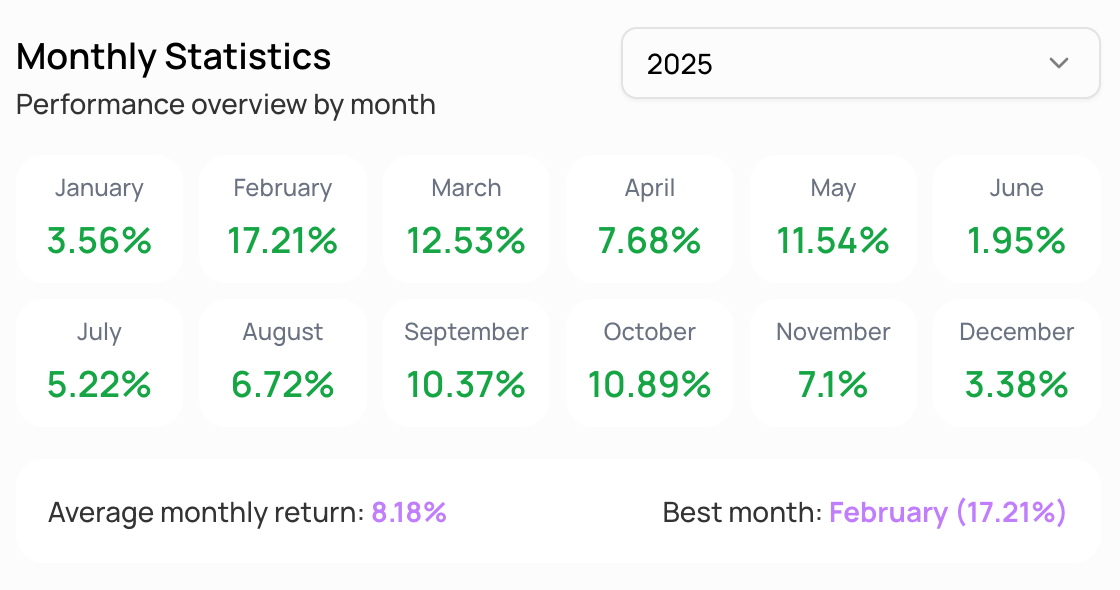
Verified copy traders can make it easier for investors to identify traders whose performance and trading activity can be independently assessed.
Copy trading has become increasingly accessible. On many platforms, users can browse hundreds or thousands of traders, compare historical returns and automatically replicate their positions. But accessibility creates another problem: how do you know whether the performance you see is genuine?
A trader showing a 150% return may look impressive. However, a performance figure alone doesn’t tell you whether the account is real, whether the results include significant hidden risk or whether the trader has a sufficiently long track record.
This is where verification becomes important.
A properly verified copy trader should provide enough reliable information for investors to evaluate the strategy based on real trading activity, historical performance and risk, rather than marketing claims or screenshots.
However, the word “verified” should also be treated carefully.
Not every verification badge means the same thing. Different copy trading platforms use different verification processes, and some may verify only certain aspects of a trader’s account.
Therefore, before copying a trader, you need to understand what exactly has been verified.
What Are Verified Copy Traders?
A verified copy trader is generally a trader whose account, performance or trading history has been checked by the copy trading platform or another independent source.
The exact definition varies between platforms.
Verification may involve checking:
- Whether the account is a real trading account
- Whether trades are actually being executed
- Historical performance
- Account ownership
- Trading history
- Risk statistics
- Drawdown
- Trade execution
- Whether performance data comes directly from the broker
The purpose is to provide investors with greater confidence that the displayed performance represents genuine trading activity.
However, verification does not mean that the trader is guaranteed to be profitable.
A verified trader can still lose money.
Verification is about the credibility and transparency of the information, not a guarantee of future returns.
Why Are Verified Copy Traders Important?
The biggest problem with evaluating traders online is that performance claims can be difficult to verify.
A trader could advertise:
“I made 300% last year.”
But where did the number come from?
Was it:
- A real account?
- A demo account?
- A single winning trade?
- A selected period?
- A highly leveraged account?
- A result before fees?
- An account with significant unrealized losses?
Without reliable data, you don’t know.
Verified trading data can reduce some of this uncertainty.
Instead of relying on screenshots or marketing claims, investors can analyze actual account statistics.
How Does Copy Trader Verification Work?
The verification process depends on the platform.
A stronger verification system may connect directly to a broker or trading account and retrieve trading data automatically.
This can provide information such as:
- Account balance
- Equity
- Profit and loss
- Open positions
- Closed trades
- Drawdown
- Trading history
- Risk metrics
Because the information comes directly from the trading account, it is more difficult to manipulate than a manually uploaded screenshot.
Some platforms may also verify the trader’s identity or require additional documentation.
But there is an important distinction:
Verified performance is not the same as verified trader quality.
A platform can verify that a trader really made +50%.
That doesn’t mean the strategy will make another +50% next year.
What Does a Verification Badge Actually Mean?
Never assume that a verification badge automatically means:
- Low risk
- Guaranteed profits
- Professional trader
- Regulated trader
- Safe investment
- Long-term profitability
A badge may simply mean that the platform has confirmed that the performance data comes from a connected account.
Before choosing a trader, find out what the platform actually verifies.
Ask:
What does “verified” mean on this platform?
That question can prevent a lot of confusion.
Verified Does Not Mean Profitable
This is perhaps the most important point.
Imagine a verified trader has the following statistics:
- Track record: 3 years
- Return: -15%
- Maximum drawdown: -25%
The trader may be completely verified.
But verification doesn’t change the fact that the strategy lost money.
Likewise, a trader can have excellent historical performance and still lose money in the future.
Verification provides evidence about what happened.
It does not predict what will happen.
Verified Copy Traders vs. Unverified Traders
The difference is mainly transparency.
| Factor | Verified Trader | Unverified Trader |
|---|---|---|
| Real account data | Usually available | Unclear |
| Trading history | More transparent | May be limited |
| Performance verification | Checked by platform | Not necessarily |
| Risk statistics | Often available | May be incomplete |
| Screenshots required | Less important | Often relied upon |
| Manipulation risk | Lower | Potentially higher |
This doesn’t mean every unverified trader is dishonest.
It simply means you have less independent evidence.
Why Screenshots Are Not Enough
Trading screenshots are easy to create and difficult to verify.
A screenshot might show:
Profit: +€25,000
But it doesn’t tell you:
- How much capital was used
- How much risk was taken
- Whether the account is real
- How much was lost previously
- Whether the position is still open
- Whether the screenshot represents the complete trading history
This is why verified account data is generally more useful.
You want to see the complete performance profile, not a single successful moment.
What Should You Check Beyond Verification?
Even with verified copy traders, you should analyze the strategy yourself.
Important metrics include:
Track Record
How long has the trader been active?
Return
What has the trader historically achieved?
Maximum Drawdown
How large was the largest peak-to-trough decline?
Recovery Time
How quickly did the trader recover from significant losses?
Leverage
How much leverage does the strategy use?
Position Size
Are positions consistently sized?
Trading Frequency
How many trades are being executed?
Win Rate
How often are trades profitable?
Risk-to-Reward Ratio
How large are average wins compared with average losses?
Current Exposure
What positions are open right now?
Verification should be the starting point, not the entire analysis.
Track Record Is One of the Most Important Factors
A verified trader with two months of history is still a relatively new strategy.
A verified trader with five years of history gives you significantly more information.
A long track record allows you to see how the strategy behaves during:
- Bull markets
- Bear markets
- Sideways markets
- High volatility
- Low volatility
- Major economic events
Past performance is not a guarantee of future results.
But a longer track record provides a larger sample of historical behavior.
Look at Maximum Drawdown
Return tells you how much money the trader made.
Drawdown tells you what you potentially had to endure to get there.
Consider two verified traders:
Trader A
- Return: +80%
- Maximum drawdown: -45%
Trader B
- Return: +35%
- Maximum drawdown: -8%
Trader A generated more profit.
But Trader B had significantly lower historical drawdown.
Depending on your risk tolerance, Trader B could be the more suitable copy trading strategy.
This is why verified copy traders should always be evaluated based on risk-adjusted performance, not just return.
Check How the Trader Uses Leverage
Leverage can dramatically change the risk profile of a strategy.
A trader can produce impressive returns using high leverage.
But the same leverage can amplify losses.
This is particularly important when copy trading Forex or CFDs.
European regulators have introduced restrictions on retail CFD leverage because of concerns about the risks these products pose to retail investors.
Therefore, when evaluating a verified trader, don’t just look at their percentage return.
Look at how much exposure they used to generate that return.
Watch for Martingale Trading
A verified trader can still use a highly aggressive strategy.
Martingale is a good example.
The trader increases position size after losses, hoping that a later winning trade will recover previous losses.
This can produce a very high historical win rate.
But a prolonged losing streak can cause exposure to increase dramatically.
Therefore, when analyzing verified copy traders, check whether:
- Position sizes increase after losses
- Losing positions are repeatedly averaged
- Exposure grows during drawdowns
- Stop losses are used
- Large floating losses are common
A verified account can verify the activity.
It doesn’t make the strategy safe.
Check for Grid Trading
Grid strategies can also create attractive historical performance.
The trader places multiple orders at different price levels and attempts to profit from repeated market movements.
The problem occurs when price moves strongly in one direction.
The strategy can accumulate increasingly large positions.
This can create substantial floating losses.
If a verified trader uses a grid system, you should understand:
- Maximum grid size
- Maximum exposure
- Leverage
- Stop-loss rules
- Historical drawdown
- Margin requirements
Again, verification doesn’t remove the underlying trading risk.
Current Positions Matter
Historical performance is useful.
But you should also look at what the trader is doing right now.
Suppose a trader has generated +40% over two years.
That’s impressive.
But they currently have a large number of highly leveraged positions open.
The historical return doesn’t tell you how much risk you’re taking at this exact moment.
If the platform provides the information, examine:
- Open positions
- Current drawdown
- Exposure
- Margin usage
- Position sizes
- Market concentration
This can provide a much clearer picture of current risk.
How to Identify High-Quality Verified Copy Traders
There is no single statistic that identifies a high-quality trader.
Instead, look for a combination of characteristics.
A potentially attractive profile might include:
- Long track record
- Transparent trading history
- Controlled drawdown
- Consistent position sizing
- Reasonable leverage
- Clear strategy
- Diversified exposure
- Stable performance
- No obvious martingale behavior
- Transparent current positions
This doesn’t guarantee future success.
But it provides a stronger basis for evaluation.
Don’t Chase the Highest Return
Leaderboards can create a dangerous psychological effect.
Imagine you open a copy trading platform and see:
#1 Trader: +280%
#2 Trader: +190%
#3 Trader: +160%
It is tempting to select the first trader.
But you don’t know the risk yet.
Maybe the #1 trader used:
- 50:1 leverage
- Large position sizes
- Martingale
- Concentrated exposure
- Extremely aggressive risk
A trader showing +40% with a 7% maximum drawdown may ultimately be a much more suitable choice.
The highest return isn’t automatically the highest-quality strategy.
Verified Copy Traders and Risk Management
Risk management should be one of your primary selection criteria.
Look at:
Maximum risk per position
How much can one trade potentially affect the account?
Maximum exposure
How much capital can be exposed at one time?
Leverage
How large are the positions relative to account capital?
Stop-loss methodology
Does the trader define where a losing trade should be closed?
Maximum drawdown
How much has the strategy historically lost from peak to trough?
These factors help you understand the downside.
Is a Verified Copy Trader Safe?
Verification can reduce certain information and transparency risks.
It cannot eliminate market risk.
A verified trader can:
- Lose trades
- Experience drawdowns
- Change strategies
- Increase leverage
- Make mistakes
- Lose money
If the trader uses leveraged products, the potential losses can be substantial.
Therefore:
Verified does not mean safe.
It means you have stronger evidence that the information being presented reflects genuine trading activity.
That distinction is extremely important.
What Makes a Copy Trading Platform More Transparent?
When evaluating a copy trading platform, look for clear information about:
- The broker
- Regulation
- Trading account type
- Performance calculation
- Fees
- Spreads
- Commissions
- Drawdown calculation
- Trader history
- Open positions
- Risk metrics
- Withdrawal conditions
A platform that only shows returns but provides little information about risk should be approached carefully.
Transparency should go beyond marketing.
Regulation and Verified Copy Traders
Verification and regulation are two different things.
A platform can have verified traders without being a regulated financial services provider in every jurisdiction.
Likewise, a regulated broker can offer access to traders whose individual strategies are still risky.
You should therefore check:
- Who operates the platform?
- Which legal entity holds your money?
- Which regulator supervises that entity?
- Is the service offered legally in your country?
- What investor protections apply?
- What exactly does the platform’s verification process cover?
Don’t confuse a verification badge with a regulatory licence.
How to Check Whether a Broker Is Legitimate
Before depositing money, verify the broker independently.
Don’t rely solely on:
- Website logos
- Testimonials
- Social media profiles
- Influencers
- Review websites
- “Regulated” claims
Go to the relevant regulator’s official register and search for the legal entity.
Regulators such as the FCA regularly warn consumers about unauthorised investment and trading firms, including firms that may imitate legitimate businesses.
This is especially important when a platform promises unusually high returns or pressures users to deposit money quickly.
Red Flags Even When a Trader Is Verified
A verification badge should never stop you from doing your own analysis.
Be cautious if you see:
- Extremely high returns over a short period
- Very high leverage
- Large increases in position sizes
- Martingale
- Aggressive averaging
- Huge open positions
- Very low drawdown combined with unusual trading behavior
- Significant strategy changes
- Pressure to increase your allocation
The more unusual the performance looks, the more you should investigate how it was achieved.
How Many Verified Copy Traders Should You Copy?
There is no universal number.
Some investors may choose one strategy.
Others may diversify across several traders.
For example:
- One Forex trader
- One index trader
- One gold trader
- One longer-term strategy
But diversification only works when the strategies have genuinely different exposures.
If all traders use similar positions, you may simply multiply the same risk.
Therefore, analyze correlation and market exposure, not just the number of traders.
Can Verified Copy Traders Guarantee Profits?
No.
No verification system can guarantee future profits.
A verified trader’s historical results are still historical results.
Markets are uncertain.
A strategy can perform well for several years and then encounter conditions it wasn’t designed for.
Any company or trader claiming that verification means guaranteed profits should be treated with caution.
A Practical Checklist for Verified Copy Traders
Before copying a verified trader, ask:
Trader
- Is the account verified?
- How long has the trader been active?
- Is the trading history transparent?
- Are the results based on a real account?
Performance
- What is the total return?
- What is the average monthly return?
- How consistent is performance?
- How long are losing periods?
Risk
- What is the maximum drawdown?
- How much leverage is used?
- What is the largest position?
- Are positions concentrated?
- Does the trader use martingale or averaging?
Strategy
- What markets are traded?
- What is the typical holding period?
- Is the strategy understandable?
- Does the strategy change frequently?
Broker
- Is the broker regulated?
- Which legal entity holds the account?
- What investor protections apply?
- What are the total costs?
If you cannot answer these questions, you probably don’t yet have enough information to make an informed decision.
Verified Copy Traders vs. Signals
Copy trading and traditional trading signals are not the same.
A signal provider might tell you:
Buy EUR/USD at 1.0800
You then decide whether and how to execute the trade.
With copy trading, the platform can automatically replicate the trader’s actions in your account.
This makes verification particularly valuable because the strategy provider’s actual trading history becomes a key part of your investment decision.
Verified Copy Traders vs. Social Media Traders
Social media can be useful for discovering traders.
But it should not be treated as proof of performance.
A trader’s Instagram or YouTube account might show:
- Winning trades
- Luxury lifestyle
- Profit screenshots
- Testimonials
But these don’t necessarily provide a complete trading history.
Verified account data is much more useful because it can show performance over time rather than isolated successful trades.
The Importance of Transparency
Ultimately, the best verified copy traders aren’t necessarily those with the most impressive marketing.
They are the traders where you can clearly understand:
What they trade.
How they trade.
How much risk they take.
How they performed historically.
How they behaved during losing periods.
What positions they currently hold.
This level of transparency allows you to make a more informed decision.
How to Choose Verified Copy Traders
A practical selection process could look like this:
Step 1: Start With Verification
Filter for traders whose performance comes from verified trading accounts.
Step 2: Remove Short Track Records
Consider whether there is enough historical data to evaluate the strategy.
Step 3: Check Drawdown
Compare maximum drawdown with historical returns.
Step 4: Analyze Leverage
Avoid blindly selecting strategies based on high returns generated through excessive leverage.
Step 5: Investigate Position Sizing
Look for consistent and understandable risk.
Step 6: Identify the Strategy
Determine whether the trader uses trend following, swing trading, scalping, grid trading or another approach.
Step 7: Examine Current Exposure
Look at open trades and current drawdown where available.
Step 8: Compare Several Traders
Don’t make your decision based on a single leaderboard position.
Step 9: Check the Broker
Verify regulation, legal entity and investor protections independently.
Step 10: Decide on Your Allocation
Only allocate capital that fits your personal risk tolerance.
Conclusion: Verified Copy Traders
Verified copy traders can provide a more transparent way to evaluate trading strategies than relying on screenshots, social media claims or isolated examples of profitable trades.
But verification should never be mistaken for a guarantee of profitability or safety.
The purpose of verification is to give you greater confidence that the trading performance and account activity you are seeing are genuine. You still need to analyze the strategy itself.
Look at the track record, maximum drawdown, leverage, position sizing, current exposure, trading frequency and risk management. Investigate whether the trader uses potentially dangerous techniques such as martingale or aggressive averaging.
At the same time, separate trader verification from broker regulation. A verified trader can still lose money, and a regulated broker cannot guarantee the performance of a strategy.
The strongest approach is therefore to use verification as one layer of due diligence, not as the entire decision-making process.
Don’t choose a copy trader simply because they have a verified badge.
Choose a trader whose performance is transparent, whose risk you understand and whose strategy fits your own objectives.
That is what makes verification genuinely useful in copy trading.
Overview of Topics